No. You must verify its flow rate, the minimum required differential pressure, the maximum allowable pressure, the operating temperature, and the water quality. The pressure-independent function only operates within the manufacturer’s specified range.
HOT WATER & HYDRONICS
Technical Selection · Supply Across Quebec and Canada
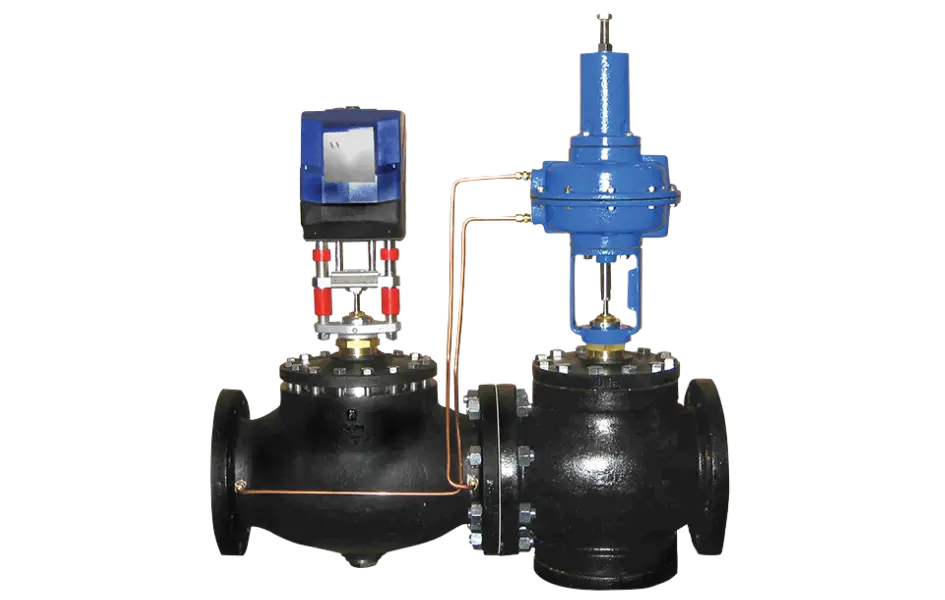
Warren Controls PICV · Dual-Function Integration
An electric control valve and a differential pressure regulator operate in tandem within the manufacturer's specified operating limits.
Warren Controls PICV · Configuration to be selected
YOUR REQUIREMENTS
SOLUTIONS
These solutions do not provide the same hydraulic performance. The loop schematic remains the essential starting point for proper selection.
MODULATE FLOW
VALVE FUNCTION & APPLICATION
Modulates flow in a branch line to precisely balance supply to the heat exchanger.
To be verified: available differential pressure and system response during valve closure.
Explore Control Valves →
DIVERT FLOW
VALVE FUNCTION & APPLICATION
Directs flow between two flow paths, functioning in either mixing or diverting service depending on its configuration.
To verify: port orientation, hydraulic schematic, and circulation requirements for both the pump and generator.
Explore the STEVI Range →
MASTERING DIFFERENTIAL PRESSURE
VALVE FUNCTION & APPLICATION
Combines flow control with differential pressure regulation across the valve.
To verify: flow rate, minimum and maximum differential pressure, temperature, and water quality.
Explore Warren Controls PICVs →
SELECTION CRITERIA
Media characteristics, thermal operating ranges, and hydraulic conditions collectively dictate the optimal valve selection and sealing solution.

Schematic representation only · actual configuration depends on your specific installation.
MATERIALS & ASSEMBLY
EPDM can be considered for select aqueous services, provided the compound, glycol content, additives, and operating temperatures are properly validated. The selection of PTFE, graphite, or composite materials must align with the specific flange design and assembly conditions.
Glycol type, concentration, additives, and treatment. These parameters directly impact sizing calculations and material compatibility.
Temperatures, thresholds, and start-up phases: generator temperature alone does not fully reflect branch line operating conditions.
Distinguish system line pressure from the available pressure drop across the valve.
Control signal, stroke or thrust, fail-safe position, flange specifications, and overall dimensions: verify the complete assembly, not just the connection.
REPLACEMENT & RELIABILITY
SELECTION EXAMPLE
Record flow rate, temperatures, and differential pressure across multiple operating conditions. Oversizing, hydraulic fluctuations, and control tuning can produce similar symptoms.
Review operating pressures, flow rates, and pressure drop distribution.
Verify actual flow rate, fouling, air entrainment, and available operating temperatures.
Verify stroke, thrust, control signal, and fail-safe position, in addition to mechanical compatibility.
FREQUENTLY ASKED QUESTIONS
LEARN MORE
YOUR PROJECT
Send us your schematic and available process data. We will evaluate the hydraulic functions, actuation, and sealing performance to deliver a tailored, technically reliable proposal.
Following our technical review: configuration comparison and proposal tailored to the selected solution. Product availability, lead times, and documentation are confirmed upon quotation.
Your application details are being transferred to our contact form.
01
Water or glycol, concentration and treatment
02
Supply, Return, and Limit Temperatures
03
Required Flow Rate and Differential Pressure
04
Wiring diagram, connections, signal, and fail-safe position
Provide the details you currently have, and our technical team will work with you to clarify any remaining specifications.