No. The bellows specifically addresses stem sealing. You must also verify the materials of construction, pressure–temperature ratings, end connections, operating conditions, and the selected valve design.
› Applications › Thermal Oil
THERMAL OIL
Valves and Gaskets for Thermal Oil Systems
A stem leak, a valve seizing at high temperatures, fluctuating thermal cycles. On a thermal oil system, selecting the right solution depends as much on the heat transfer fluid as it does on your facility's real-world operating conditions. VAMECA partners with you to specify, replace, and supply your industrial valves and sealing solutions with proven reliability.
Technical Selection · Supplying Québec and Across Canada
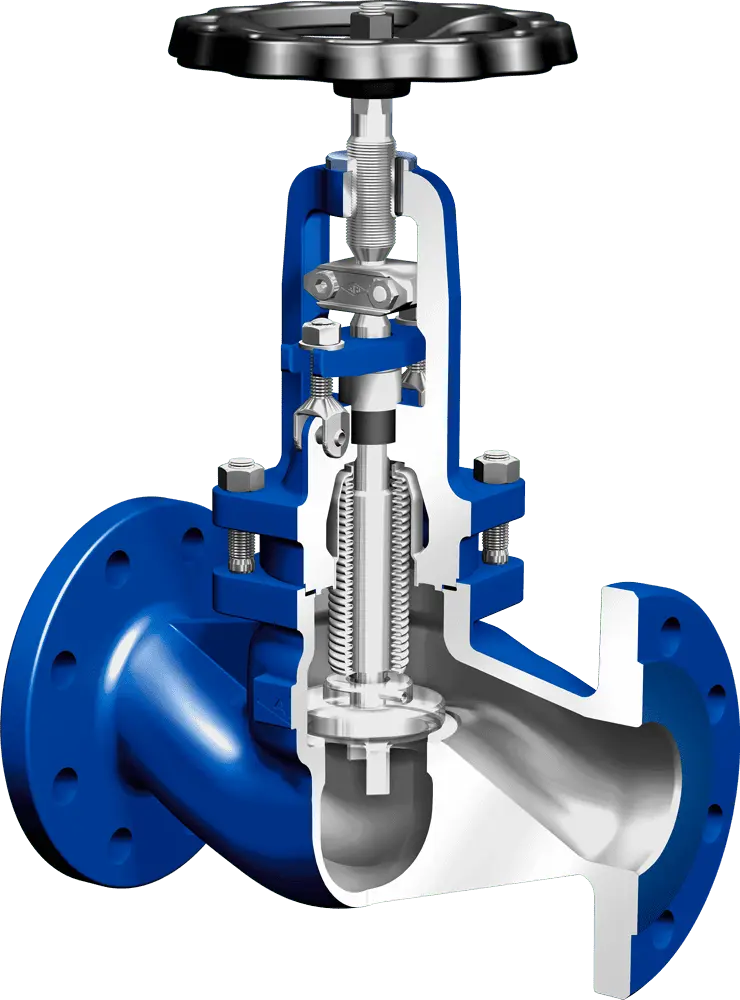
Stem Sealing: Understanding Bellows Seals
Cross-section of an ARI-FABA stop valve. The metal bellows isolates the media from the moving stem. The specific configuration must be selected to match the intended service conditions.
Indirect Heating · Circulation Loops · Maintenance
REAL-WORLD OPERATING CONDITIONS
Select for high-temperature operating conditions… and start-up cycles
Thermal fluid transfers heat from a generator to process equipment such as heat exchangers, jacketed vessels, or dryers. Operating temperature, cold-start viscosity, and duty cycles are all key engineering criteria for proper selection.
Actual Temperature
Please specify normal operating temperatures, anticipated maximums, and any startup or shutdown conditions. Note that the process media limits and the valve's pressure-temperature ratings represent two distinct engineering validations.
Pressure and Flow
Static pressure is not sufficient. Please specify the upstream and downstream pressures, flow rate, and allowable pressure drops, including conditions when the oil exhibits higher cold-start viscosity.
Expansion and Assembly
Piping systems must accommodate thermal expansion and contraction. Valves must not be subjected to structural loads caused by misaligned piping. Trapped liquids subject to heating require a dedicated thermal relief protection analysis.
UNDERSTANDING THE APPLICATION
Analyze system operating conditions before valve selection
In an indirect heating loop, industrial valves must provide reliable equipment isolation, precise heat transfer modulation, and consistent circulation conditions as specified by design engineering.

Application example. Configuration and equipment to be specified based on your installation requirements.
Generators and Pumps
The generator's minimum flow rate and pump suction conditions define the operating parameters of the loop.
User Operations and Process Control
The valve is sized based on the required flow rate and differential pressure. Matching the pipe diameter is not a valid sizing rule.
Expansion and Return
Expansion volume, deaeration, and return temperatures are critical system design parameters—they cannot be determined by the valve alone.
SELECTABLE TECHNOLOGIES
Four functions, distinct choices
Isolate with Bellows Seal Technology
ARI FABA valves are among the manufacturer's premier technologies engineered for thermal oil service. The bellows seal design effectively eliminates the stem leakage path. Be sure to separately verify seat tightness, body material compatibility, differential pressure limits, and expected cycle life.
Regulate heat transfer
An ARI STEVI control valve can be engineered for your process system. Key selection criteria include the Cv/Kv sizing, flow characteristic, actuator type, fail-safe position, and sealing design. An oversized valve can compromise precision control at lower flow rates.
Mastering Differential Pressure
A discharge or bypass solution can address circulation requirements depending on your system architecture. ARI-PRESO configurations engineered for thermal oil must be evaluated based on specific pump and flow conditions. Please note that they do not replace dedicated overpressure protection.
Ensuring Reliable Isolation for Large-Diameter Applications
A metal-seated triple offset butterfly valve may be considered depending on the service conditions. Operating temperature, pressure class, torque requirements, allowable leakage rate, and face-to-face dimensions must be confirmed against the exact design configuration.
MATERIALS & SEALING SOLUTIONS
Gasket selection depends on both the media fluid and the flange specifications
Please provide the commercial designation of the media along with its technical data sheet. "Thermal oil" does not fully specify chemical composition or seal operating limits. Maximum pressure and temperature ratings on a material data sheet do not necessarily apply simultaneously.
A new gasket cannot compensate for damaged flanges, piping misalignment, or improper bolting. Tightening must strictly follow the assembly procedure.
MAINTENANCE & REPLACEMENT
A recurring leak demands more than just a gasket replacement
Selection Example · Leakage After Multiple Cycles
A flange remains leak-free when cold, but begins weeping once operating temperatures rise. Before performing a like-for-like material replacement, document the exact onset of the leak, the condition of the flange faces, the gasket installed, and the bolt-torquing procedure. These parameters are essential for evaluating the entire bolted assembly.
A hot oil leak and saturated insulation require immediate on-site intervention. Schedule the service work in accordance with standard cool-down, isolation, and lockout/tagout (LOTO) procedures.
Stem leakage
Identify the construction, bellows or packing design, and operational history.
Unstable control
Record the minimum and maximum flow rates, pressures, and valve position during temperature fluctuations.
Build-up or Difficult Operation
Review the fluid condition, dead legs, and actual thermal conditions directly with the operator.
VAMECA SUPPORT & TECHNICAL EXPERTISE
Prepare Your Valve Selection or Replacement
Do you have a part number, a nameplate, or an instrument loop diagram? We cross-reference this data with your operating conditions to build an actionable manufacturer request.
Technical Resources
Oil Name and Technical Data Sheet
Normal, Minimum, and Maximum Operating Temperatures
Upstream/Downstream Pressures and Flow Rates
Size, Pressure Class, Flanges, and Face-to-Face Dimensions
Actuation, Signal, and Fail-Safe Position
Photos, existing part number, and required documentation
Clarify the function
Isolation, control, backflow prevention, or protection: we define the exact requirements and operating conditions to specify to the manufacturer.
Compare Configurations
We assess materials, interfaces, actuation, and project-specific documentation.
Plan Procurement
You will receive a proposal tailored to your selected configuration. Availability, lead times, and documentation are confirmed upon quotation.
FREQUENTLY ASKED QUESTIONS
The Expert Answers You Need Before Specifying
Reliable selection starts with accurate specifications. Here are the key details our team typically requires for replacement or sizing requests.
LEARN MORE
Your Application in Context
Partner Technical Documentation
YOUR SPECIFIC APPLICATION REQUIREMENTS
Need to replace a valve in your oil system?
Provide your part number and operating conditions, and our local technical experts will help you refine your valve and sealing selection to deliver a tailored, reliable quote.