Chilled water refers to cooled water. Glycol water contains glycol, whereas saline brine contains dissolved salts. These fluids do not necessarily share the same properties or material compatibility constraints. Determining the exact chemical composition remains the critical starting point for proper equipment selection.
INDUSTRIAL COOLING
Technical Selection · Supply Across Quebec and Canada
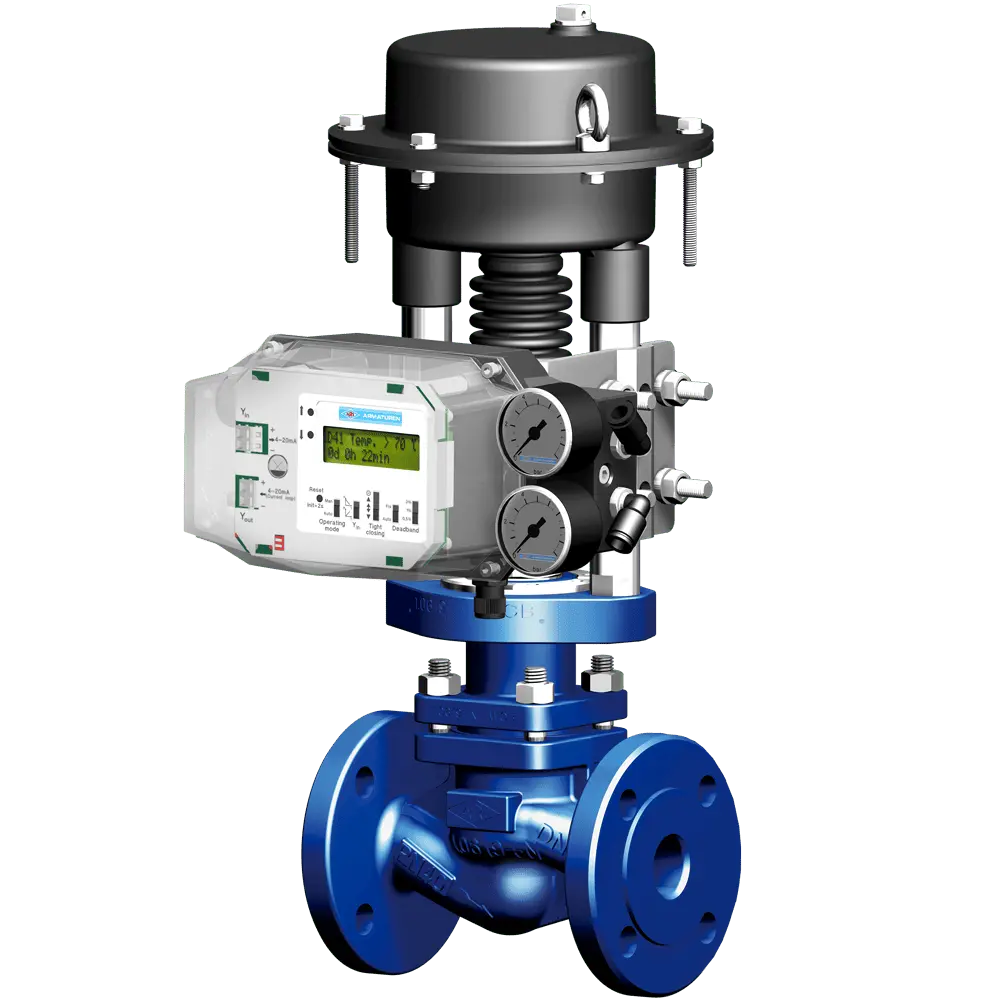
ARI STEVI · Cooling Flow Control
A comprehensive line of control valves engineered to meet your specific process fluid, flow rate, pressure, and operating temperature requirements.
Product range visual · The configuration shown is not a tailored selection for your specific installation.
IDENTIFY PROCESS MEDIA
01
Chilled Water
Chilled water in an HVAC or process loop. Review water treatment and circulation conditions.
Please specify: minimum design temperature and water quality requirements.
02
Glycol-water solution
Water-glycol mixture. Identify the type, concentration, and additives prior to calculation and seal selection.
Please specify: ethylene glycol or propylene glycol, as well as concentration by weight or by volume.
03
Brine
Salt brine is not glycol-water. The specific type of salt, inhibitors, and wetted materials must be identified.
Please specify: exact composition, concentration, and temperature.
This page covers secondary cooling loops. Valves for primary refrigeration circuits, specifically for ammonia or CO₂ applications, are featured in a dedicated selection.
SELECT FUNCTION
Proper selection begins with the piping schematic and actual operating conditions. Compatibility with water alone does not qualify a valve for glycol, brine, or sub-zero temperatures.
MODULATE FLOW
VALVE FUNCTION & APPLICATION
Modulates flow within a branch to fine-tune exchanger or process cooling.
Key parameters to review: chiller minimum flow rate, available differential pressure, and low-load operation.
Explore Control Valves →
DIVERT FLOW
VALVE FUNCTION & APPLICATION
Mixes or diverts fluid between two flow paths, depending on valve construction and connection design.
Key considerations: port orientation and flow requirements. A three-way valve is not interchangeable with a two-way valve.
Explore the STEVI Range →
MASTERING DIFFERENTIAL PRESSURE
VALVE FUNCTION & APPLICATION
Combines flow control with differential pressure management within the manufacturer's specified range.
Warren Controls PICV: water and glycol-water solutions within documented operating limits. Do not use for brine or sub-zero applications below 0°C.
Explore Warren Controls PICVs →
Isolate a line for maintenance
Select ball or butterfly valves based on process media, seat materials, minimum design temperature, and clearance constraints.
View Industrial Valves →
Automate the cooling valve
Electric or pneumatic actuation tailored to motion, torque, and control requirements. The PS Automation product lines should be evaluated based on the complete valve assembly.
Explore PS Automation →
KEY FACTORS THAT DETERMINE YOUR SELECTION
Concentration and temperature directly affect fluid properties. Calculations for flow capacity, whether Cv or Kv, must be based on the actual media mixture data.

Loop with heat exchanger and control devices · Schematic illustration only, not an installation drawing or a customer project.
BODIES, SEATS, AND SEALS
Material compatibility must be verified across all wetted parts, not just the valve body. For chlorinated brine services, a generic "stainless steel" rating is insufficient. The precise seal compound, chemical additives, and operating temperatures remain critical deciding factors.
Composition and Concentration
Record the trade name, fluid data sheet, specific glycol or salt used, and the concentration. Never assume density and viscosity are identical to those of water.
Minimum Temperature and Freeze Protection
Specify supply, return, start-up, and shut-down. The mixture's freeze protection and the valve's allowable temperature rating require two separate verifications.
Flow Rate and Differential Pressure
Document the minimum, normal, and maximum flow rates, system pressure, and available pressure drop across the valve. Pipe size alone is insufficient for proper valve sizing.
Steam trapping, isolation, and actuation
Ensure continuous insulation, clear operating access, and proper environmental conditions for the actuator. Verify the signal, power supply, output torque/thrust, and fail-safe position of the complete assembly.
REPLACEMENT & RELIABILITY
CONDITION REQUIRING ASSESSMENT
Collaborate to verify operating temperatures, actual flow rate, media concentration, filtration, and available pressure. Sizing up to a larger valve isn't automatically the solution.
Compare performance under low- and high-load conditions before modifying the valve or actuation controls.
Distinguish process fluid leakage from surface condensation on cold components. Inspect insulation integrity as well.
Switching from water to glycol, or from glycol to brine, requires re-evaluating your valve selection rather than simply reordering the existing model.
FREQUENTLY ASKED QUESTIONS
LEARN MORE
YOUR PROJECT
Please provide the media specifications, operating conditions, and a photo or schematic. Our specialists will evaluate your requirements for isolation, control, actuation, and sealing performance.
The proposal specifies the selected configuration. Operating limits, availability, lead times, and documentation are confirmed in the quotation.
Your application details are being transferred to our contact form.
01
Exact media, concentration, additives, and technical data sheet
02
Supply, Return, and Operating Limit Temperatures
03
Upstream/downstream flow rates and pressures, or differential pressure
04
Part number, size, end connections, actuation, and image
Provide the details you currently have, and our technical team will work with you to clarify any remaining specifications.