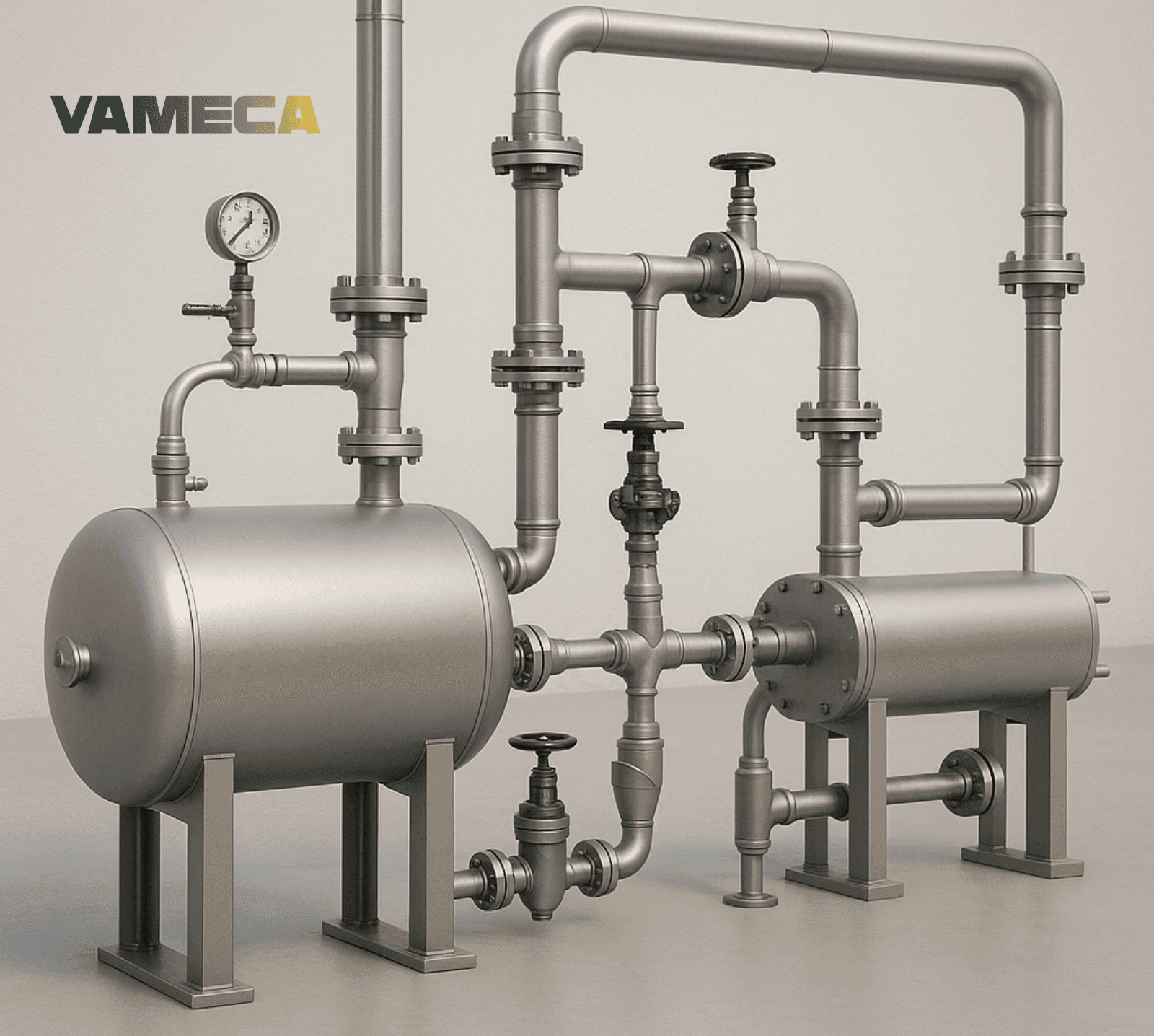
In a world obsessed with electricity and batteries, steam remains one of the most understated, and most powerful, pillars of modern industry.
Steam: a universal energy carrier
Before being a word associated with a kettle or an old train, steam is first and foremost a highly efficient form of thermal energy.
As water vaporizes, it stores a massive amount of heat. This heat can then be transported, controlled, released, condensed and reused. It's a simple, efficient, and fully controllable cycle.
It is this ability to transfer energy with remarkable precision and stability that makes steam an irreplaceable tool in plants, power stations and district heating networks around the world.
Why we still “generate steam”
In the 2020s, most Canadian industries still use steam for three main reasons:
Transfer heat at scale.
Thanks to its high latent heat, steam carries a much higher energy density than hot air, making it a particularly efficient thermal medium for industrial networks. It is the most efficient solution for heating processes, tanks, or industrial buildings.Ensure stable, controlled temperature.
In pharmaceutical, food, or chemical sectors, thermal consistency is critical: a difference of just a few degrees can compromise an entire production run.Power mechanical processes.
Turbines, pumps, generators: steam can also be converted into mechanical or electrical energy, notably in power plants and industrial process facilities.
Industrial sectors that still depend on steam in Canada
Steam is everywhere around us, often invisible:
Sector | Application examples |
|---|---|
Food processing | Cooking, sterilization, CIP washing, pasteurization |
Pharmaceutical & biotech | Tank heating, equipment sterilization, distillation |
Energy & district heating | Steam-condensate distribution, combined heat and power production |
Pulp & paper & textiles | Drying, surface treatment, tensioning |
Metallurgy & foundry | Mould preheating, heat treatment, high-temperature cleaning |
The majority of major industrial sites in Canada still use internal steam networks, sometimes connected to local thermal plants or biomass plants.
Technical challenges of a steam network
Working with steam means working with a demanding medium:
High pressures, temperatures above 300 °C, corrosive condensate and constant load variations.
Every component — valve, check valve, trap, safety valve, sensor — must be designed to withstand, control and last.
The slightest leak or poorly calibrated purge can result in significant energy losses.
That is why manufacturers, operators and distributors such as VAMECA focus on:
The safety (ASME, CRN, CSA)
Mechanical reliability (stainless steel, cast iron, high-temperature alloys)
And energy performance through control and condensate recovery systems.
Why choose VAMECA for your steam applications
At VAMECA, we support industrial operations from coast to coast in the design, modernization and reliability improvement of their steam networks.
Our approach:
Expertise built on more than 30 years of technical distribution in industrial valves.
Proven and certified products: ASME, CRN, API, ISO, CSA.
A complete range adapted to steam and condensate:
globe valves and ball valves,
check valves,
steam traps,
safety valves,
automation and control accessories
Local service — fast, responsive and bilingual — to support your operations across Canada.
In summary
We generate steam because it remains one of the safest, most precise and most cost-effective ways to transfer heat in industry today.
But for a steam network to perform, it requires reliable equipment, properly sized and compliant with Canadian standards.