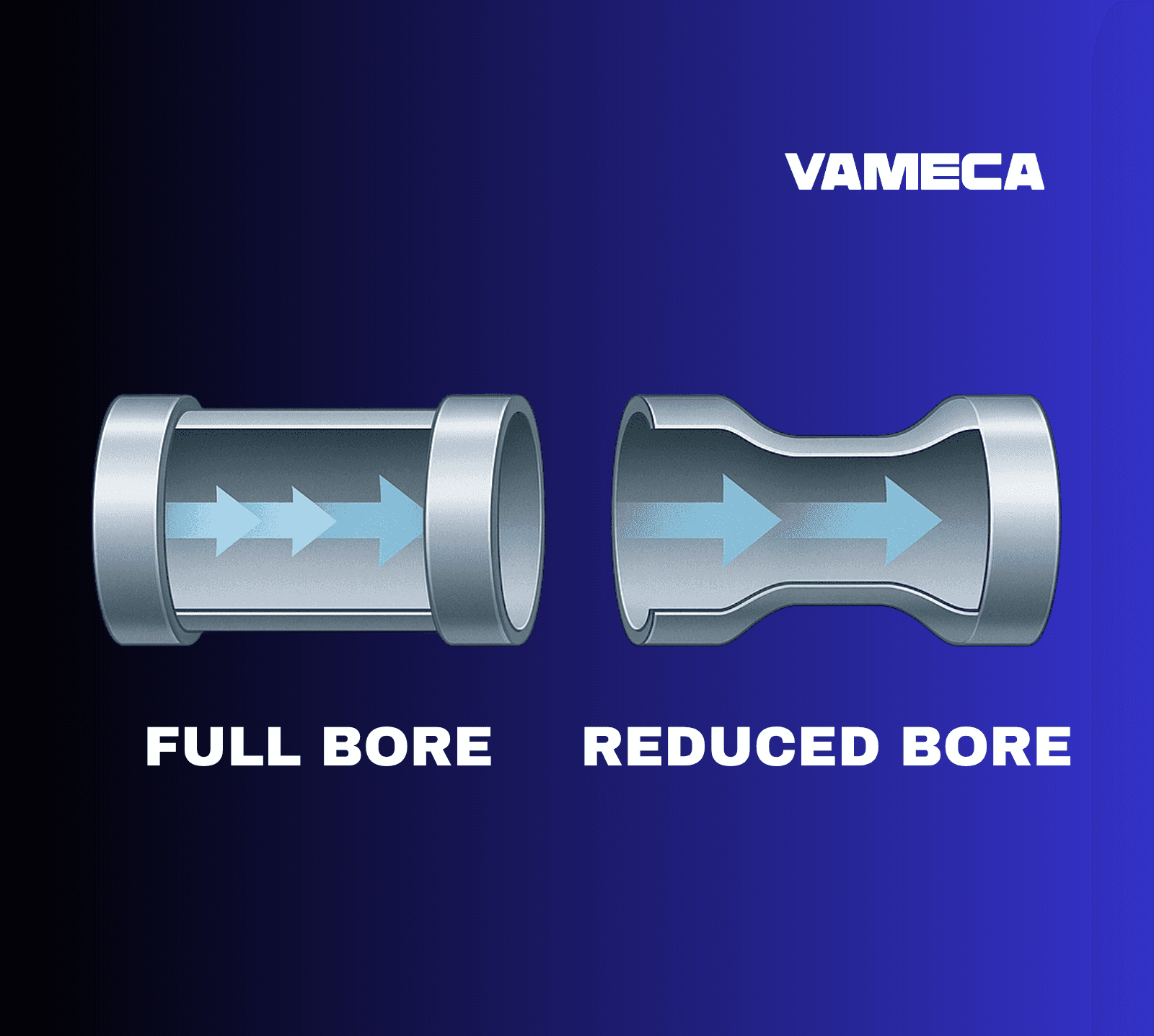
In industrial valve technology, one frequently asked question is: should you choose a full-bore or reduced-bore valve?
On paper, the difference seems minor. In reality, this decision directly influences the flow rate, energy consumption, and the lifespan of your equipment.
Full-Bore: Free Flow
A full-bore valve maintains the same inner diameter as the piping.
Result: the fluid flows without restriction, minimizing pressure loss and greatly reducing wear on internal components.
It's the right choice when:
The flow rate is high or variable, as on main lines;
The fluid contains sludge, particles, or fibres (wastewater, pulp, mining processes);
You wish to limit fugitive emissions and cavitation;
The line is piggable (scraper or mechanical cleaning);
Unplanned shutdowns are costly to operations.
Reduced-Bore: An Economical Compromise
The reduced-bore presents a smaller bore than the conduit.
The valve is more compact, less expensive to purchase, but creates a permanent restriction in the flow.
Relevant for:
Non-critical utilities (service water, compressed air, glycol circuits);
Small diameters where flow differences remain negligible;
Applications where the priority is on unit cost rather than performance.
But be cautious: on pumping or steam networks, this reduction often leads to energy overruns amounting to thousands of dollars annually.
The “saving” at purchase quickly becomes a poor calculation in the medium term.
Concrete Use Cases
Water treatment stations: full-bore on sludge or raw water lines; reduced-bore possible on ancillary utilities.
District heating networks: full-bore recommended on buried or variable flow sections.
Steam applications: always full-bore on main isolations, otherwise risk of erosion and noise.
Mining sector: full-bore with reinforced seats to avoid clogging and premature wear.
Chemical industry: reduced-bore tolerated on cooling loops or auxiliary circuits only.
Common Mistakes to Avoid
Mixing full-bore and reduced-bore on the same line: this creates uneven velocities and turbulence.
Underestimating maximum flow rate — the calculation must include wash or purge phases.
Forgetting the impact on the pump: every 0.1 bar of unnecessary loss constitutes consumed power and dissipated heat.
Ignoring the effect on the actuator: more loss = more torque = oversized motorization.
Choosing solely based on purchase price — while the energy cost is paid every day of operation.
Bottom Line
Full-Bore = performance, flow, reliability, lifespan.
Reduced-Bore = lower initial cost, but quicker losses and wear.
The right choice depends on your fluid type, the criticality of the line, and your profitability horizon.