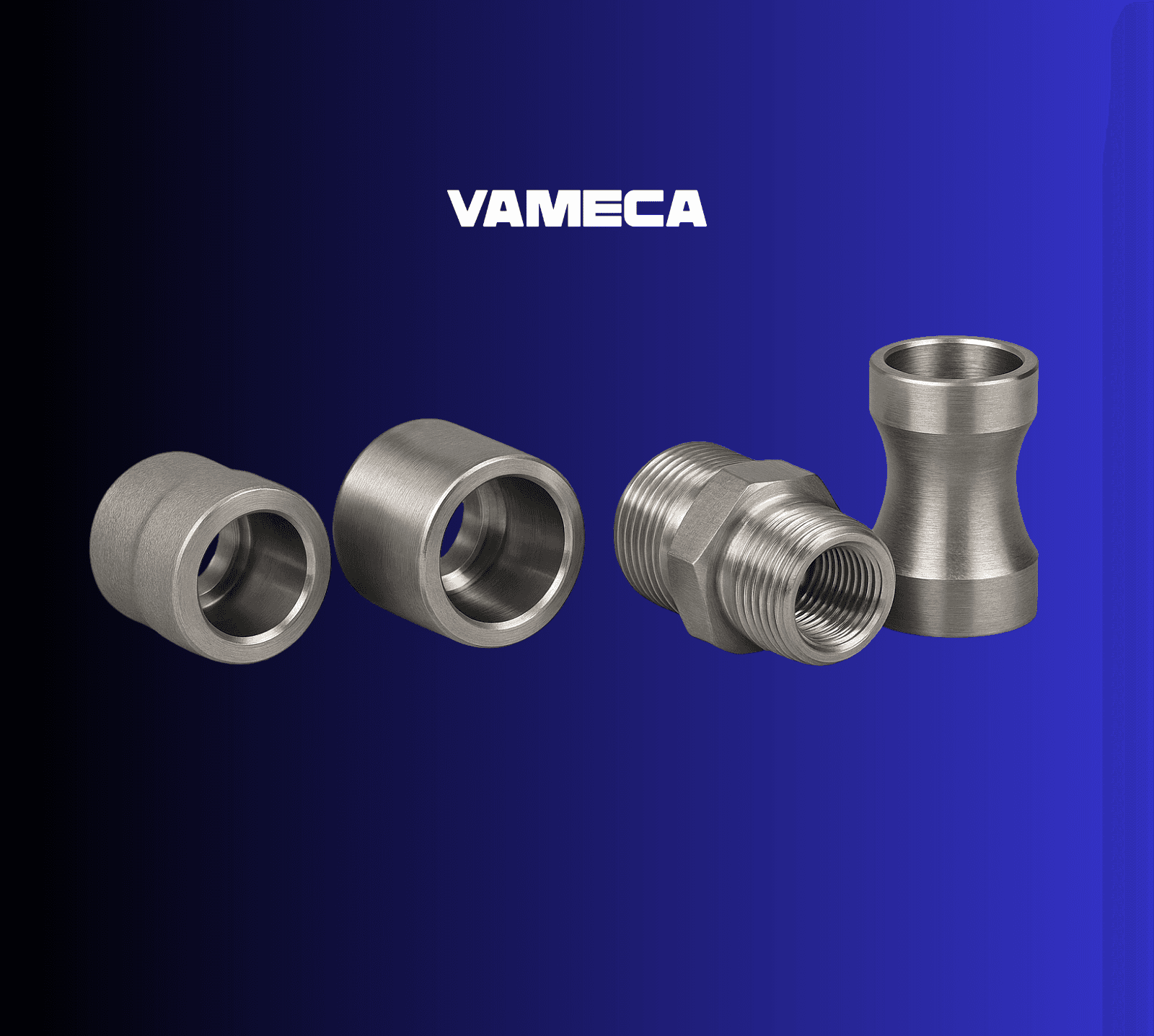
In an industrial network, the performance of a valve depends as much on its internal design as it does on the chosen mode of connection. Too often overlooked, this detail nonetheless dictates the seal integrity, durability, and maintainability of the installation. An improper connection can lead to leaks, complicate interventions, or create major regulatory incompatibilities.
The connection is the link between the valve and the process. It determines the mechanical, thermal, and hygienic continuity of the system. Choosing it correctly ensures process safety, regulatory compliance, and long-term maintenance ease.
Main Connection Types
Threaded Connection (NPT and BSP)
The threaded connection remains the most widespread solution for small diameters.
NPT (National Pipe Thread) dominates in North America, while BSP (British Standard Pipe) remains common on equipment of European origin.
These two thread types are incompatible with each other.
The threading is suitable for compressed air, water, or oil networks but shows its limits beyond 20 bar or at high temperatures, where the risk of leakage becomes real.
Flange Connection
The flange connection is predominant in most industrial installations.
It facilitates disassembly, inspections, and valve replacement.
The choice of drilling depends on the standards used: ASME B16.5, DIN/EN or PN/Equivalent Class.
Flanges provide excellent mechanical and thermal hold, while remaining compatible with most spiral wound or composite gaskets.
For a detailed overview of the different types of gaskets, consult the complete guide on sealing materials.
Welded Connection and Orbital Welding
The welded connection is preferred in high-pressure, steam, or hydrocarbon networks.
It ensures perfect continuity between the valve and piping.
The butt-weld and socket-weld versions offer maximum resistance, at the cost of more complex maintenance.
Orbital welding, increasingly used in pharmaceutical and microelectronics sectors, allows a clean and repeatable joint, without inclusions or porosity, ideal for high-purity environments.
Clamp, Tri-Clamp, and SMS Connection
The clamp connection or tri-clamp, of sanitary origin, dominates in the food, cosmetic, and biopharmaceutical sectors.
It allows quick disassembly without tools and complete CIP/SIP cleaning.
Its hygienic design and polished finish reduce retention areas and ensure compliance with 3A, FDA, and ISO 2852 standards.
The SMS connection (Swedish Manufacturing Standard), still widely used in dairy plants and liquid food processes, provides a robust alternative to tri-clamp.
It ensures excellent centering and good mechanical resistance, while remaining compatible with sanitary cleaning systems.
Venturi Connection
Some specific systems like Venturi connections are used when generating a vacuum effect, mixing, or flow measurement is required.
These setups require perfect geometric consistency between sections and materials to ensure the precision of fluidic behavior.
They are often integrated into instrumented lines, in conjunction with control valves or differential flowmeters.
Technical Criteria for Optimal Choice
Pressure and Temperature
The primary parameter to evaluate is the operating pressure and temperature.
A threaded connection will suffice up to 20 bar and 100 °C, whereas a weld or flange connection is preferable when conditions become severe.
Orbital and tri-clamp connections offer excellent performance for clean processes but should not be used beyond their nominal mechanical limits.
Fluid Type
The type of fluid directly influences the choice of connection.
Corrosive, abrasive, or high-viscosity products require compatible materials and suitable gaskets: filled PTFE, graphite, FDA-certified EPDM, etc.
Sterile or ultra-pure fluids require polished surfaces and hygienic connections like the tri-clamp or orbital welding.
Maintenance and Accessibility
Maintenance is a decisive criterion.
On a line that must be opened regularly, a flange or clamp connection greatly simplifies operations.
Conversely, a permanent network subject to strong vibrations or steam justifies the use of welding.
Standards and Compliance
Pressure installations in Canada must comply with CSA B51 requirements and CRN registrations specific to each province.
A connection compliant with ASME or ISO standards does not automatically guarantee regulatory compliance without local validation.
To delve deeper into this subject, discover our article on CRN standards and equipment compliance in Canada.
Common Errors
Confusing NPT and BSP threads inevitably leads to irreparable leaks.
Neglecting thermal expansion on a welded network causes mechanical stress and weld breakage.
Under-sizing the gasket or using a material not compatible with the fluid directly compromises seal integrity.
Choosing a permanent connection on a line requiring periodic dismantling is a design error that results in costly maintenance.
A Reasoned and Sustainable Approach
Choosing the right connection is not simply about linking two parts.
It is a technical decision that dictates the safety, productivity, and compliance of the industrial process.
The approach must be holistic: understand fluid constraints, anticipate maintenance, validate normative compliance, and select the most sustainable technology.
At VAMECA, we assist engineers, integrators, and maintenance managers in the selection and configuration of their valve equipment.
We validate the mechanical, thermal, and regulatory compatibility of connections according to current standards in Canada and North America.
For any technical validation request or selection assistance, our specialists can analyze your plans and recommend the most suitable connection for your process, whether it involves a steam installation, food network, or sterile environment.