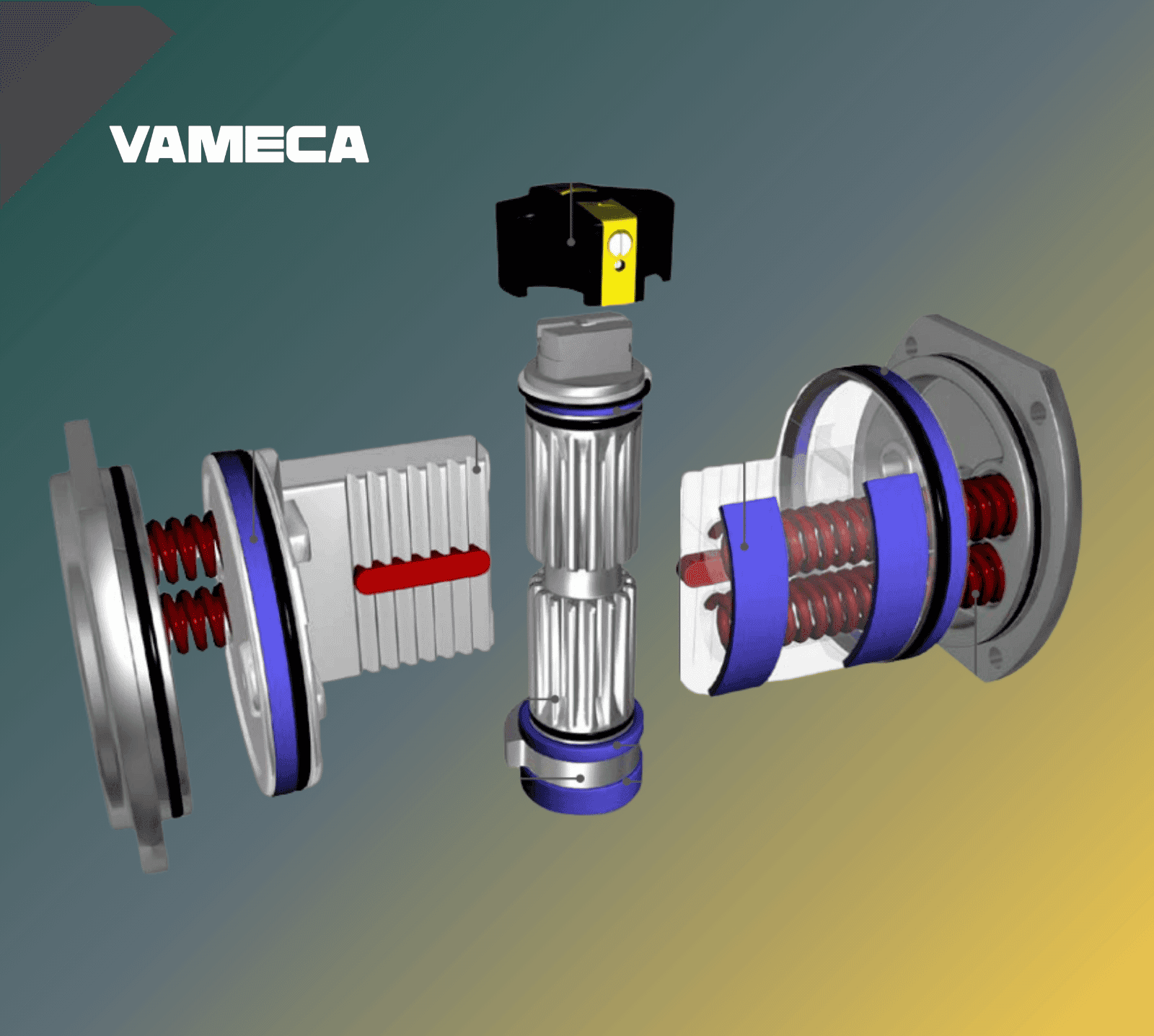
In industrial valve technology, the pneumatic actuator converts air pressure into mechanical motion to operate a valve, whether it is a quarter-turn or a linear-stroke valve.
It is what determines process responsiveness, installation safety, and flow stability, often invisible to the operator but essential to proper system operation.
Used across all sectors—energy, water treatment, petrochemicals, mining, and food processing—pneumatic actuators are available in several technologies to meet torque, actuation speed, environmental, and safety constraints.
The main families of pneumatic actuators
Double-acting actuator: precision, consistency, and motion control
The double-acting actuator (Double Acting) uses compressed air to open and close the valve through two chambers supplied alternately.
This system delivers constant torque throughout the stroke, making it ideal for repetitive operations or large-diameter valves.
ADVANTAGES | LIMITATIONS |
|---|---|
Consistent, fully controlled torque | No fail-safe position in the event of air supply loss |
Controlled actuation speed | Requires two pneumatic lines (supply/exhaust) |
No internal spring ⇒ limited mechanical wear | |
Excellent performance on large-diameter valves or continuous-duty applications |
Applications: automated processes, flow control, continuous flow regulation.
Single-acting actuator: built-in safety
Also known as spring return, the single-acting actuator uses an internal spring to automatically return the valve to a safe position (open or closed) in the event of a pressure drop.
It offers high reliability for critical applications.
ADVANTAGES | LIMITATIONS |
|---|---|
Built-in safety = fail-safe function (safe position) | Lower available torque than an equivalent size |
Reduced air consumption | Requires proper spring sizing based on the valve and service |
Simplified maintenance | |
CSA/UL compliant for critical installations |
Applications: gas or steam circuits, safety units, emergency shutdowns.
Rack-and-pinion actuator: the industry standard
The rack-and-pinion mechanism is now the most widely used for quarter-turn valves.
The linear movement of the pistons drives the rotation of the central pinion: a simple, robust, and economical design.
ADVANTAGES | LIMITATIONS |
|---|---|
Compact, modular, and reliable construction | |
Constant torque and smooth motion | |
Compatible with ISO 5211 and Namur interfaces | |
Easy maintenance | |
Wide range of accessories: solenoid valves, sensors, positioners |
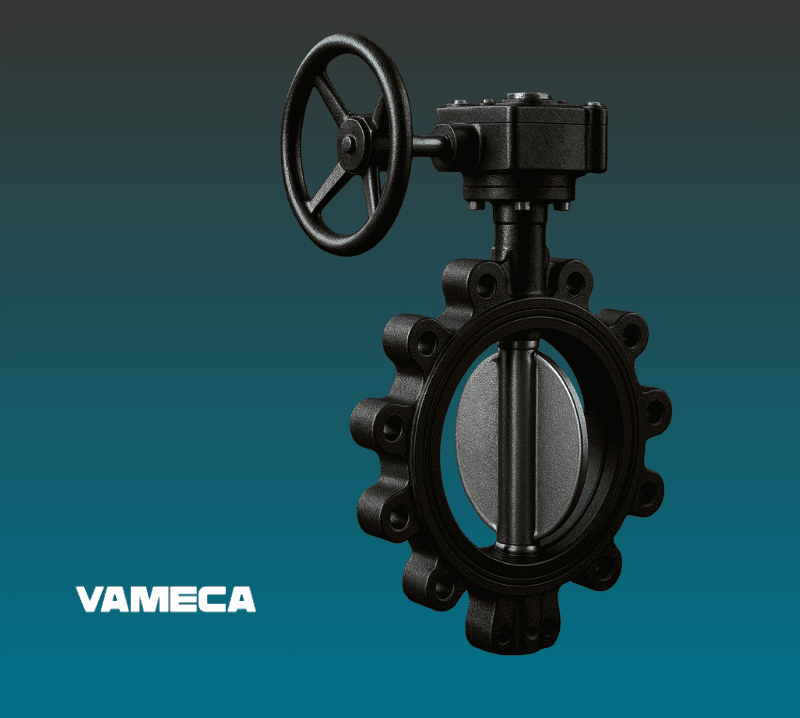
Applications: butterfly, ball, and plug valves; air/water/oil networks.
Scotch Yoke actuator: the solution for high torques
The Scotch Yoke actuator stands out for its ability to deliver very high torque at the start and end of stroke, which are critical zones during valve opening or closing. Here, the linear movement of the piston is converted into rotation via a Y-shaped lever, producing very high torque at the start and end of stroke, where forces on the valve are greatest. It is preferred in high-pressure environments or severe service conditions.
ADVANTAGES | LIMITATIONS |
|---|---|
Higher starting and end-of-stroke torque than rack-and-pinion | Larger footprint |
Excellent energy efficiency | More complex mechanics ⇒ higher maintenance costs |
Suitable for high-resistance valves (trunnion ball, high-pressure butterfly) | |
Available in single- or double-acting versions, often CSA/UL Class I Div. 2 certified |
Applications: oil & gas, fluid transfer, pipelines, cryogenic service, and high-torque-demand sectors.
Diaphragm actuator: the specialist in fine control
The diaphragm actuator is dedicated to linear valves (globe, stop, control).
Compressed air acts on a flexible diaphragm that moves the stem: an ideal system for control loops requiring a high level of precision.
ADVANTAGES | LIMITATIONS |
|---|---|
Very high control sensitivity | Limited stroke |
Low friction ⇒ long service life | Not suitable for high rotary torques |
Excellent performance in clean environments (pharmaceutical, food processing) |
Applications: pressure/temperature/flow regulation, precise dosing.
Variants, options, and operating conditions
To meet industrial requirements (particularly North American), actuators can include:
CSA / UL certifications: compliance for use in hazardous locations (HazLoc) and integrated electrical components.
Corrosion-resistant coatings: electroless nickel plating, hard anodizing, epoxy paint
Reinforced materials: high-strength aluminium, 316 stainless steel for aggressive environments
High-performance seals: Viton, EPDM, NBR depending on temperature and fluid
Control options: position indicator, torque feedback, integrated control enclosure, electro-pneumatic positioner
These options help optimise service performance, safety, and regulatory compliance.
How do you choose the right pneumatic actuator?
Proper sizing is essential to ensure system reliability. The criteria to assess are:
Valve type (quarter-turn or linear)
Required torque (starting, dynamic, end-of-stroke)
Available supply pressure
Service conditions: temperature, humidity, corrosion
Applicable standards: CSA, UL, ISO 5211, Namur
Operational objective: safety, control, automation
A well-chosen actuator reduces air consumption, optimises service life, and limits maintenance interventions.
Conclusion: compressed air, a discreet yet essential driver of industrial installations
Robust, reliable, and versatile, pneumatic actuators remain at the heart of industrial automation.
Whether it is a rack-and-pinion model for versatility, a Scotch Yoke for high torques, or a single-acting unit for safety, they provide the essential link between your processes and your performance requirements.