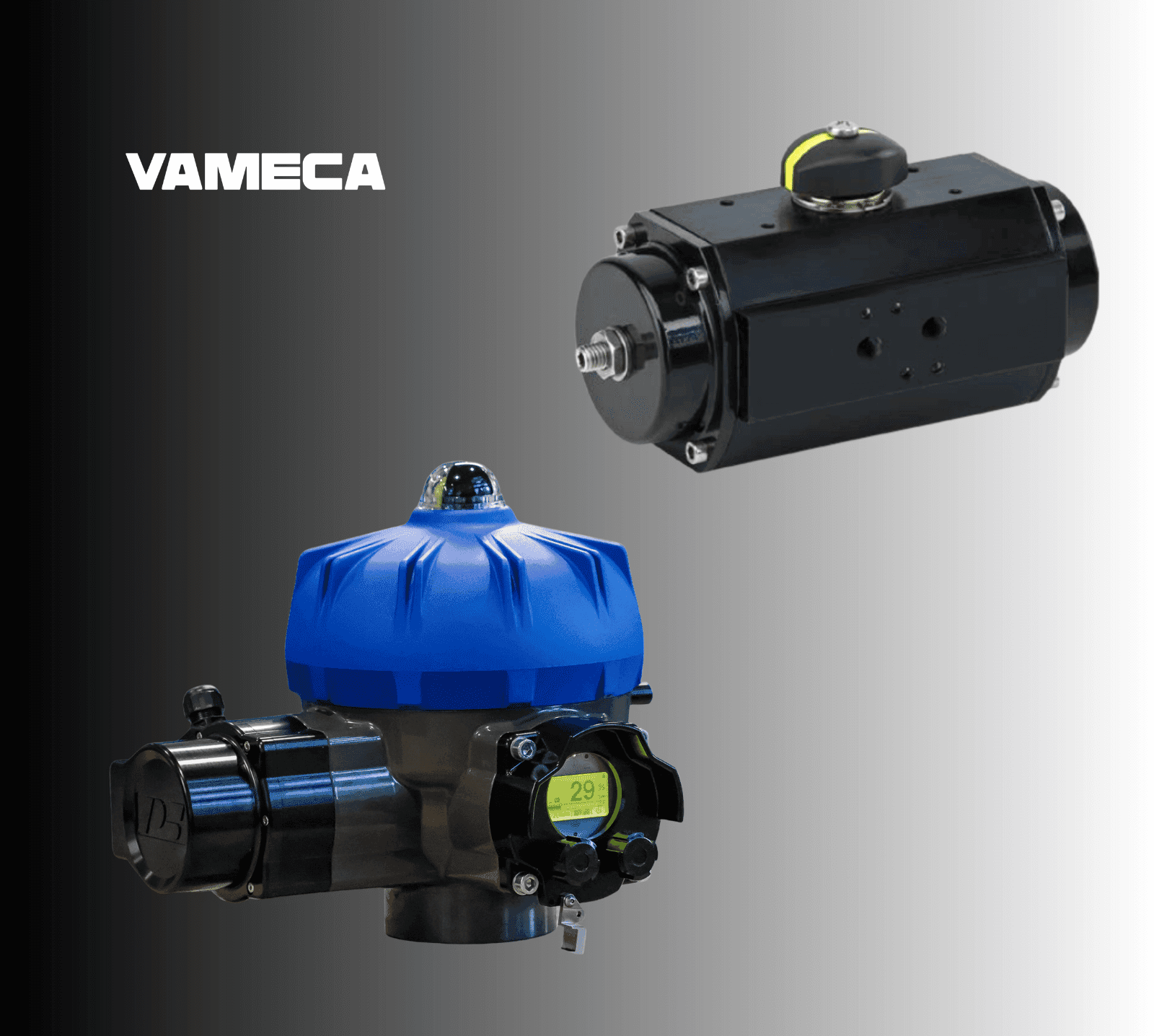
In an industrial network, the type of actuator determines everything: process availability, control precision, operational safety, and long-term maintenance.
In the North American market, two technologies dominate: pneumatic and electric.
They meet different criteria: speed and durability on one hand, precision and integration on the other.
Pneumatic Actuation
Speed, Endurance, and Safety
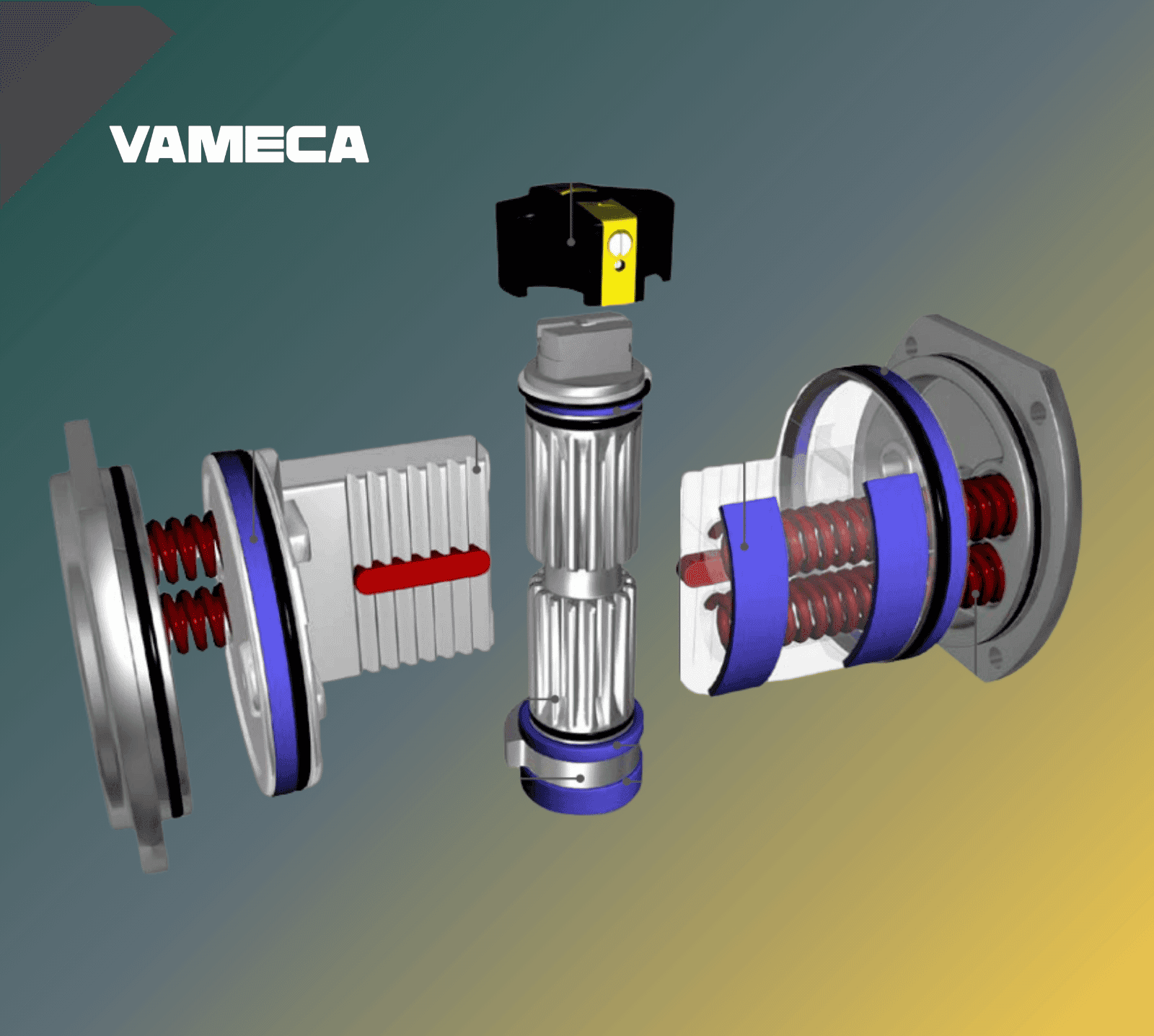
A pneumatic actuator uses compressed air to open or close the valve. It is the most prevalent technology in process plants: water treatment, chemical, energy, food processing, mining, or pulp and paper.
Why it’s the Industry Standard
Fast and Repeatable: complete operation in 1 to 3 seconds, with a consistent cycle over time.
Enduring: withstands harsh conditions (cold, humidity, dust).
Safe: option to add a spring return (fail-safe) to ensure closure in case of air loss.
Reliable: simple architecture, few sensitive components, low failure rate.
Considerations
The air must be dry, filtered, and regulated between 6 and 8 bar to prevent internal corrosion.
The effective torque is directly dependent on supply pressure: an unstable network can slow the operation.
Excessive oversizing can prematurely wear out seals and slow down kinematics.
Application Areas
On/off valves, steam, compressed air, glycol, or chemical networks. Ideal when speed and durability take precedence over positioning precision.
Electric Actuation
Precision, Control, and Digital Integration
An electric actuator converts electrical energy into rotary or linear motion. It is essential in automated installations and supervised environments (PLC, SCADA, DCS).
Reasons to Choose It
Precise Control: ideal for control valves and intermediate positions.
Simplicity of Installation: no compressor or air network to maintain.
Connectivity: diagnostics, position feedback, Modbus or analog communication.
Clean and Quiet: no air leakage or discharge into the environment.
Watch Outs
Slower Operation (5 to 30 s depending on torque).
Requires an appropriate protection index (IP67 or IP68) for outdoor areas.
Limited torque for very large diameters.
Dependency on stable electricity supply.
Application Areas
Water circuits, HVAC, energy, and any process where precise control and system command integration are priorities.
Pneumatic or Electric: Which to Choose?
Criterion | Pneumatic | Electric |
|---|---|---|
Operation Speed | Very fast (1–3 s) | Medium to slow (5–30 s) |
Frequency of Use | High | Medium |
Maintenance | Air and seals | Gear motor |
Installation Cost | Higher if air network needs to be created | Lower without compressed air |
Control and Supervision | Simple, 2 positions | Fine positioning, integrated diagnostics |
Environmental Resistance | Excellent | Good with IP 67+ |
Safety in Power Cut | Possible spring return | Battery or by-pass |
Typical Applications | Industrial processes, steam, air, glycol | HVAC, water treatment, regulation |
Summary
Pneumatic is favored in demanding environments where robustness and speed are critical.
Electric excels in automated installations and applications where control precision is paramount.
At VAMECA, each actuator is dimensioned according to actual service conditions: differential pressure, temperature, maneuver frequency, environment, and safety constraints.
Our objective: ensure that your valve, your actuator, and your control function as a unified system — reliable, precise, and durable.