In industrial valve technology, choosing the type of flange is far more than a matter of dimensions. It is a critical factor that affects the safety, compatibility, and compliance of a project.
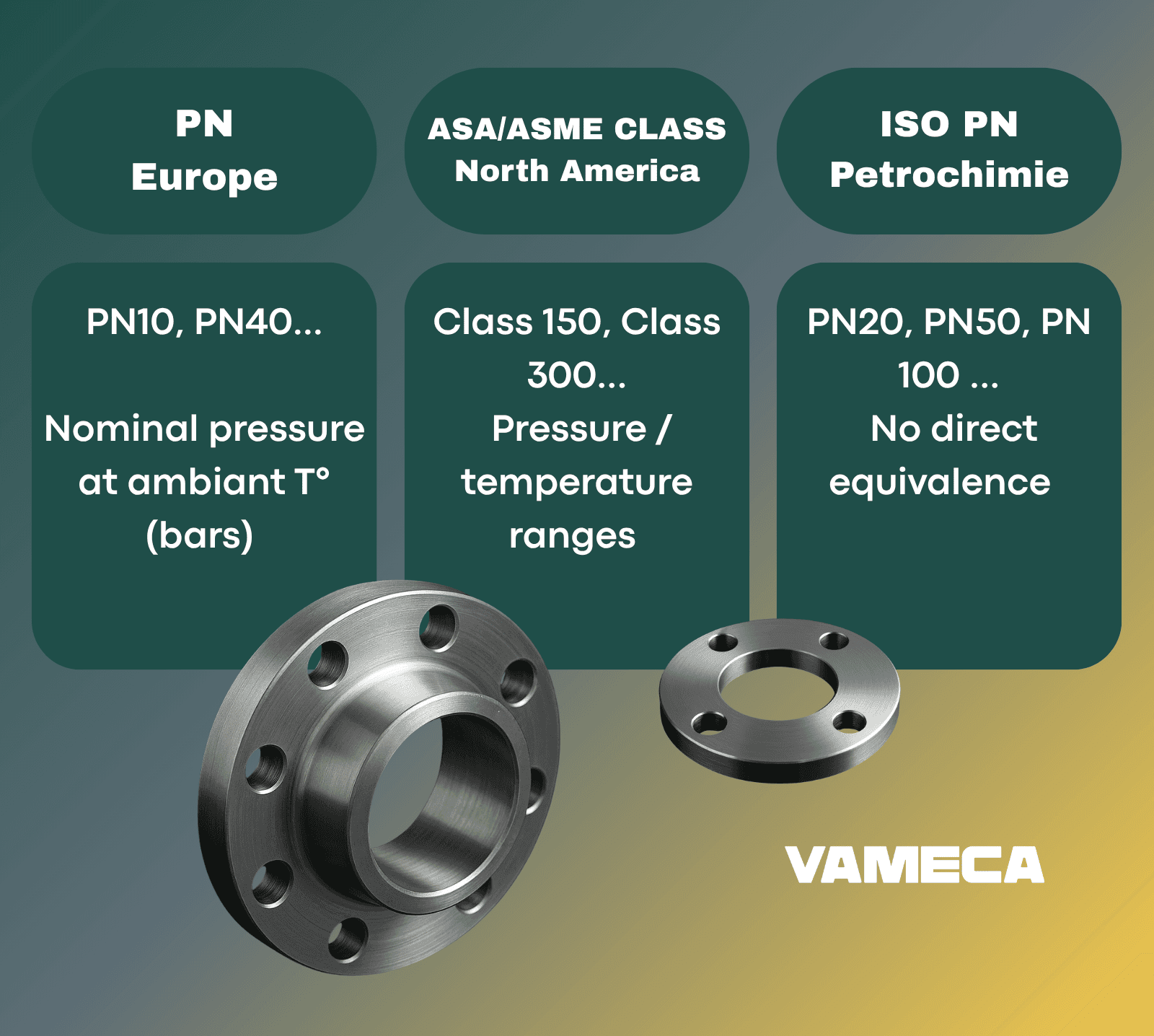
In North America and Europe, flanges adhere to different standards: PN (nominal pressure) in Europe, ASME in North America, and ISO PN in specific petrochemical markets. Misinterpreting these standards can lead to delays, additional costs, and disputes during acceptance.
This guide clarifies the significant differences and offers practical benchmarks for your specifications.
1. PN, ASME, ISO: three different logics
PN (Nominal Pressure) — European approach
The designation PN (e.g., PN 10, PN 25, PN 40) corresponds to a maximum pressure in bar at ambient temperature.
Example: PN 10 = 10 bar max at 20 °C.
However, note: as the temperature increases, the mechanical strength of the flange decreases.
ASME Class — North American approach
In North America, ASME pressure classes are used (e.g., Class 150, 300, 600…).
These classes are not expressed in bar but define specific pressure/temperature ranges according to the material (carbon steel, stainless steel, alloy…).
Main reference: ASME B16.5 (flanges up to NPS 24) and ASME B16.47 (beyond).
ISO PN — a hybrid standard
Some petrochemical industries use ISO PN (PN 20, 50, 100…), similar to American classes but without perfect equivalence.
Indicative example:
ISO PN 20 ≈ Class 150
ISO PN 50 ≈ Class 300
ISO PN 100 ≈ Class 600
ISO PN 150 ≈ Class 900
ISO PN 250 ≈ Class 1500
ISO PN 420 ≈ Class 2500
👉 Key takeaway: a PN 100 is not equivalent to an ISO PN 100. This confusion is common and must be contractually clarified.
2. Drilling and dimensional compatibilities
Another common pitfall lies in flange drilling (number of holes and bolt circle diameter):
DN 15 to DN 50: identical drilling for PN 10/16/25/40.
DN 65 to DN 150: identical drilling for PN 10/16 as well as for 25/40.
This sometimes allows for mechanical interchangeability but not pressure/temperature compatibility.
3. Types of flange faces
The type of face plays a crucial role in sealing:
RF (Raised Face): most common standard.
FF (Flat Face): used on cast iron or low-pressure applications.
RTJ (Ring Type Joint): special machining for high pressures/temperatures and hazardous fluids.
Stamped Collar: avoid for sleeve valves and high pressures.
👉 For toxic fluids, significant pressures, or high temperatures, prioritize RTJ faces or special machinings.
4. Practical comparison PN ↔ ASA ↔ ISO
Standard | Example | Typical Application |
|---|---|---|
PN (Europe) | PN 10, PN 40 | Water, heating, utilities |
ASME Class | Class 150, Class 300… | North America, heavy industries |
ISO PN (petrochemical) | PN 20, 50, 100… | Refining, international projects |
👉 In North America, ASME B16.5 is the indispensable reference. Equivalence tables are only used to translate a European specification, never for dimensioning.
5. Common risks and how to avoid them
PN / Class Confusion
➡️ Risk: specifying PN 40 in a Canadian project → supplier misunderstanding.
✅ Solution: always translate to ASME Class for the NA market.
Mixing PN and ISO PN
➡️ Risk: believing a PN 100 = ISO PN 100 → non-compliance at acceptance.
✅ Solution: require written validation from the client and specify the exact standard.
Wrong choice of flange face
➡️ Risk: leakage or incompatibility with the gasket.
✅ Solution: specify the face (RF, RTJ, FF) and the associated gasket class in the specification.
6. Best practices for purchasing and specification
Always start with ASME B16.5/B16.47 if the project is North American.
Translate European PN into Class using an indicative table, but always verify pressure/temperature curves.
Specify the flange face (RF, FF, RTJ) according to the fluid and pressure.
Document material certificates (NA compliant MTRs, EN 10204 accepted if equivalencies).
Check local availability of gaskets and flanges to avoid downtime.
7. Practical Cases
Municipal potable water project: Class 150 RF, epoxy-coated ductile iron body, FF gaskets.
High-pressure steam project: Class 600 RF, steel body, metal/graphite spiral-wound gaskets.
Refinery project: Class 900 RTJ, alloy steel body, API 6FA fire-safe requirements.
Conclusion
The selection and specification of flanges determine the safety, compliance, and durability of an installation.
👉 Best practice in North America:
communicate in ASME Class rather than PN,
check flange face and gasket compatibility,
clarify any ISO PN reference before ordering.