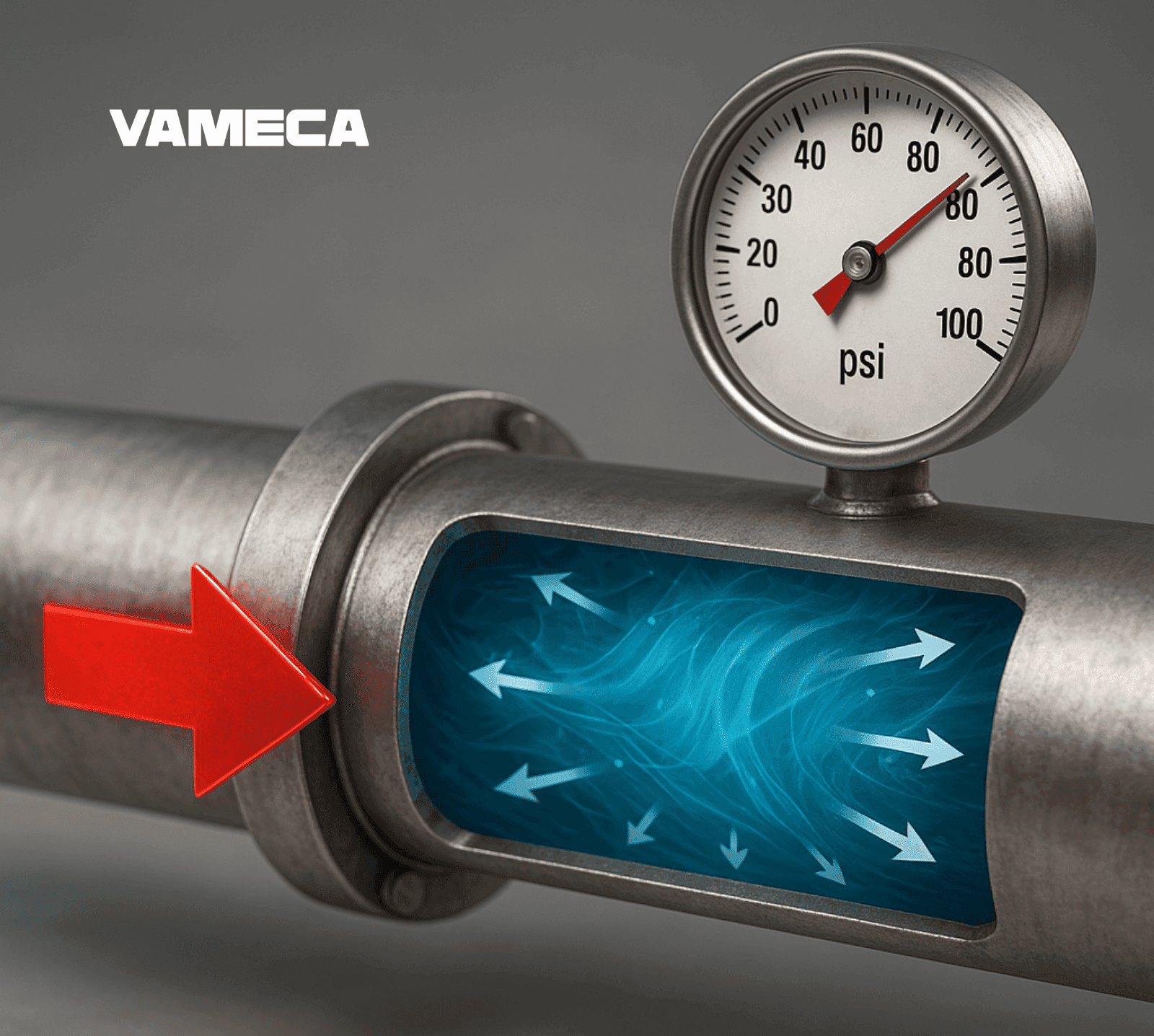
In the industrial world, pressure is an omnipresent concept, but often misunderstood. Whether discussing steam, water, compressed air, or natural gas, pressure determines equipment sizing, installation safety, and process performance.
For an engineer, technician, or industrial buyer, understanding what pressure is and how it is expressed is fundamental to selecting the right components, from the valve to the regulator.
What is pressure?
In physics, pressure is the force exerted on a given surface.
It is simply defined as:
Pressure = Force / Surface
It is generally expressed in Pascal (Pa) in the international system, but in North American industry, the most commonly used units are psi (pound per square inch) and bar.
1 bar = 14.5 psi
1 psi = 6.895 kPa
In other words, the higher the pressure, the greater the force the fluid exerts on the walls of pipes, valves, or tanks.
Absolute, gauge, and differential pressure: the crucial nuance
In industrial installations, three types of pressure are distinguished:
Absolute pressure (Pabs): measured relative to absolute vacuum.
Example: a complete vacuum = 0 bar abs.Gauge pressure (Pgauge): measured relative to atmospheric pressure (approximately 1 bar).
Example: 5 bar gauge = 6 bar absolute.Differential pressure (ΔP): the pressure difference between two points in a circuit, essential for sizing control valves and calculating the flow rate.
These distinctions are critical: a unit error between bar abs and bar g can cause oversizing or failure of the equipment.
Why is pressure so critical in industrial valve selection?
Because it conditions the entire valve choice:
Pressure class (PN or ANSI Class) according to ASME B16.34 or EN 1092-1 standards,
Compatible materials (carbon steel, stainless steel, alloys),
Service temperature,
Type of fluid (gas, steam, corrosive liquid, etc.).
Excessive pressure can lead to mechanical failure or seal failure, while too low pressure compromises process performance.
That's why every industrial valve — whether it's a ball valve, butterfly valve, or control valve — is certified for a specific pressure range (for example PN40 or Class 300).
Pressure and safety: a major regulatory concern in Canada
In Canada, the design and certification of pressure equipment are governed by the CSA B51 Code and provincial regulations like those of RBQ in Quebec.
Equipment must obtain a CRN (Canadian Registration Number) to be authorized for installation.
These requirements ensure staff safety, legal compliance, and the durability of installations.
How to measure and control pressure?
The most common instruments include:
Manometers and transmitters for measurement, automation, and supervision
Regulators and automatic valves to maintain pressure within the desired range.
Safety valves (to release pressure in case of excess),
Integrating these devices is part of the control and regulation solutions that VAMECA supports on a daily basis in Quebec and Canadian industries.
In summary
Understanding pressure is understanding the language of fluids.
This enables correctly sizing a network, avoiding incidents, and guaranteeing optimal performance.
At VAMECA, we assist our clients in selecting equipment suited to pressure, temperature, and service conditions — according to prevailing North American standards.