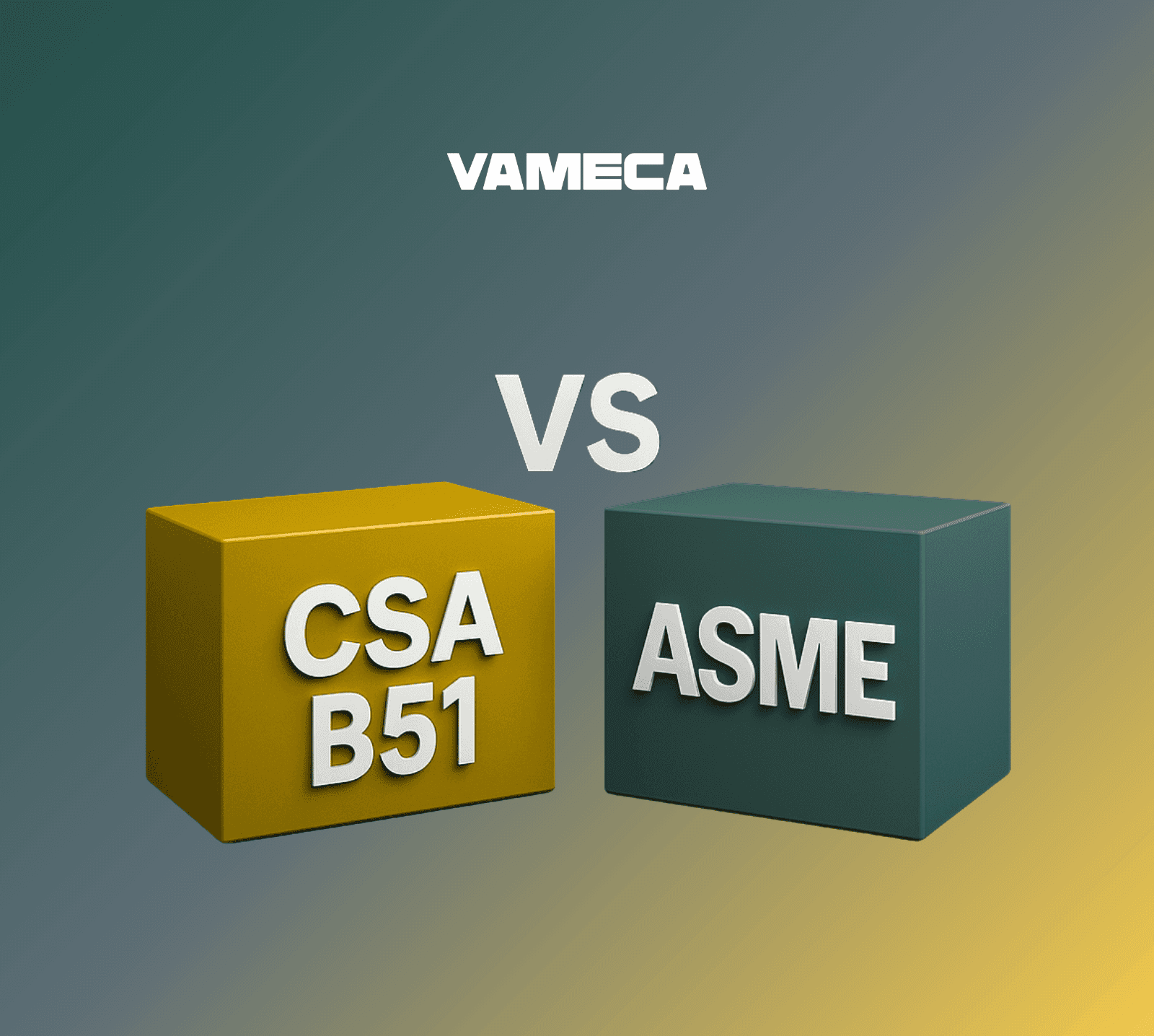
CSA B51 vs. ASME: Pressure Equipment Compliance
The safety of boilers, pressure vessels, and industrial piping relies on rigorous technical codes. In the United States, ASME (American Society of Mechanical Engineers) standards are the benchmark, whereas in Canada, the CSA B51 code plays a central role. For Canadian engineers and industrial clients, understanding how these North American codes align is essential to guarantee legal compliance and installation safety.
Key Reference Codes in North America
ASME publishes the primary, internationally recognized design and construction codes for pressure equipment. The ASME BPVC (Boiler and Pressure Vessel Code) covers pressure vessels and boilers, while the ASME B31 series applies to pressure piping systems (B31.1 for power piping, B31.3 for process piping). These documents define the criteria for design, material selection, fabrication, inspection, and testing.
Canada utilizes these same codes as its technical foundation, but governs them through the CSA B51 code, which harmonizes their application at both national and provincial levels.
Overview of the CSA B51 Code — 2024 Edition
The latest active edition is CSA B51:24, published in April 2024. This is the twentieth edition of a code with a history dating back to 1939.
A Major Structural Shift in the 2024 Edition
The 2024 edition has been reorganized into a lifecycle format, helping code users quickly locate requirements relevant to their specific stage of work. In practice, the code is no longer divided into "Parts" as in the 2019 edition; requirements are now grouped under four primary clauses: conformity assessment and quality control systems (Clause 4); equipment classification (Clause 5); equipment manufacturing (Clause 6); and in-service equipment owned by the user (Clause 7).
The previous contents of Parts 2 and 3 have been redistributed: Part 2 requirements (CNG/H₂ cylinders) have been removed to be integrated into CSA HGV 2 and CSA NGV 2, while Part 3 requirements (fueling stations) have been incorporated into the main body of the code.
Notable New Technical Requirements
The 2024 edition introduces new impact testing requirements for pressure vessels and pressure piping, which have raised questions across the industry. These requirements specifically target equipment exposed to very low temperatures — a concrete engineering challenge in the Canadian climate.
The 2024 edition also expands post-weld heat treatment requirements during the fabrication of pressure vessels, notably incorporating units in ammonia service.
Code Scope
CSA B51 outlines the minimum requirements for the design, construction, installation, operation, inspection, testing, and repair of boilers, pressure vessels, pressure piping, and fittings.
The code does not apply to pressure components in hydraulic elevators, electrical equipment containment vessels, onboard storage cylinders for natural gas or hydrogen in vehicles, or pressure vessels used for transporting dangerous goods regulated by Transport Canada.
The Role of ASME Codes in the United States
ASME codes are the primary reference standards for boilers (Section I), pressure vessels (Section VIII), and piping (B31.1, B31.3, etc.). They are recognized by inspectors, end-users, and insurance companies worldwide.
An ASME-certified vessel (bearing the ASME stamp) is generally acceptable in the U.S., but is not sufficient in Canada: it must also obtain provincial registration, indicated by a CRN (see below).
CSA B51 / ASME Harmonization
Canada uses ASME as its technical baseline, but CSA B51 takes precedence in the event of a conflict: when a clause of the CSA B51 code contradicts a referenced code or standard, the CSA B51 requirements govern.
CSA B51 complements ASME codes from a regulatory and organizational standpoint without duplicating calculation rules. In practice, a manufacturer designs to ASME standards and then submits the design to Canadian jurisdictional authorities for approval and registration.
Key Differences: CSA B51 vs. ASME
Comparison Point | ASME (United States) | CSA B51 (Canada) |
|---|---|---|
Technical Baseline | International design standard | Relies on ASME; governs in case of conflict |
Legal Mandate | Varies by state | Mandatory in all provinces and territories |
Scope of Equipment | As defined by ASME | Broader definition (covers more equipment) |
Registration | Not required | CRN required per province of operation |
Pressure Fittings | ASME/API compliant, unregistered | CRN required if pressure exceeds 15 psi (1 bar) |
Provincial Variations | Uncommon | Numerous (ABSA, RBQ, TSSA, Technical Safety BC, etc.) |
Climate Adaptation | Not specified | Impact testing for low temperatures (B51:24) |
Current Active Edition | ASME BPVC 2023 | CSA B51:24 (adoption timelines vary by province) |
The CRN: The Critical Requirement for the Canadian Market
The Canadian Registration Number (CRN) is the cornerstone of pressure equipment compliance in Canada. Without this certification, a boiler, pressure vessel, or pressure fitting cannot legally be operated or installed in Canada.
The CRN is granted by each Canadian province or territory through an authorized safety authority for any boiler, pressure vessel, or fitting operating at a pressure exceeding 15 psi (1 bar).
Province-by-Province Registration
Pressure equipment must be registered in every province or territory where it will be operated. A manufacturer wishing to market equipment across Canada must, in theory, file design submissions with multiple jurisdictions, which can be time-consuming and expensive.
However, a simultaneous registration process exists: in Quebec, for example, the RBQ allows a single application submission to be processed provincially and forwarded to other target provinces and territories.
Lead Times and Process
Securing a CRN is a formal legal process that typically takes 4 to 12 weeks, depending on design complexity and current filing backlogs in the destination jurisdiction. A typical submission package includes ASME calculations, detailed drawings showing materials and dimensions, application forms, and occasionally test results or finite element analysis (FEA).
How to Read a CRN
A CRN consists of a letter, four digits, and a decimal point followed by up to ten digits and three letters. The first digit or letter to the right of the decimal point indicates the province that issued the registration. The letter "C" may follow this designation if the design has been registered across all Canadian jurisdictions.
Provincial Authorities: Roles and Jurisdictions
Each province manages its own regulatory body. The primary authorities are:
Alberta: Alberta Boilers Safety Association (ABSA)
British Columbia: Technical Safety BC
Ontario: Technical Standards and Safety Authority (TSSA)
Quebec: Régie du bâtiment du Québec (RBQ)
Saskatchewan: Technical Safety Authority of Saskatchewan (TSASK)
Manitoba: Inspection and Technical Services (ITS)
Nova Scotia, New Brunswick, NL, PEI, Territories: ACI Central handles submissions for several of these smaller jurisdictions
Regulatory expectations can vary between provinces: for instance, Alberta (ABSA) and Ontario (TSSA) have different submission portals, review priorities, and documentation preferences.
Focus on Quebec
The RBQ is the sole authorized inspection body for pressure equipment manufacturing approvals in Quebec. It requires submissions to be provided in French or in a bilingual format for specific files.
In-Service Inspections
Beyond initial design engineering registration, operating equipment is subject to recurrent in-service inspections. In Quebec, if mandated by law, the owner or user is responsible for ensuring the vessel is approved by the RBQ prior to operation. Once active, the equipment must be inspected periodically by an inspector or organization recognized by the RBQ, which issues an active inspection certificate. In Ontario, frequency ranges from one to three years depending on applicable regulations.
Ongoing Harmonization: Streamlining Interprovincial Compliance
A CRN Reconciliation Agreement was signed in 2018 to reduce regulatory overlaps between provinces. Previously, a manufacturer selling to all provinces had to submit their design seven separate times through independent processes — a practice long recognized as costly, lengthy, and a barrier to investment. While reconciliation efforts continue, not all jurisdictions adopt new code editions simultaneously, which can introduce discrepancies during equipment design and registration.
Practical Steps for Industrial Operators
For pressure equipment destined for Canada, the standard compliance pathway is:
Design to the relevant ASME Codes (BPVC Section VIII for vessels, B31.3 for process piping, etc.)
Verify the active version of CSA B51 in the destination province(s), as adoption of the 2024 edition varies.
Apply for the CRN with the appropriate provincial authority early in the engineering phase to account for the 4-to-12-week processing times.
Plan for multi-jurisdiction registration using simultaneous registration pipelines if the equipment is bound for multiple Canadian markets.
Ensure the nameplate displays both the ASME certification mark and the CRN for every target province.
Establish in-service inspection schedules upon commissioning according to provincial regulatory frequencies.
Conclusion
ASME and CSA B51 are not contrasting standards; they are complementary. ASME establishes the technical baseline for engineering and fabrication, while CSA B51 enforces regulatory compliance in Canada with localized provincial amendments. The 2024 edition of CSA B51 marks a significant structural update — featuring a lifecycle format, updated impact testing requirements, and integrated CNG/H₂ fueling standards — that must be accounted for by engineering teams and manufacturers.
For any project destined for Canadian industrial facilities, addressing CRN requirements early in the design stage is the most reliable strategy to prevent project delays, compliance rejections, or operational shutdowns.