In industrial settings in Canada and the United States, CSA/UL compliance is an essential requirement for any equipment installed in Hazardous Locations (HazLoc). Misunderstanding or underestimating these rules can lead to inspection rejections, project delays, or even the invalidation of insurance coverage.
At VAMECA, we support North American industries by providing equipment that complies with CSA/UL standards, already documented and ready for use. But first, here’s an educational reminder of the essential concepts to master this regulatory framework.
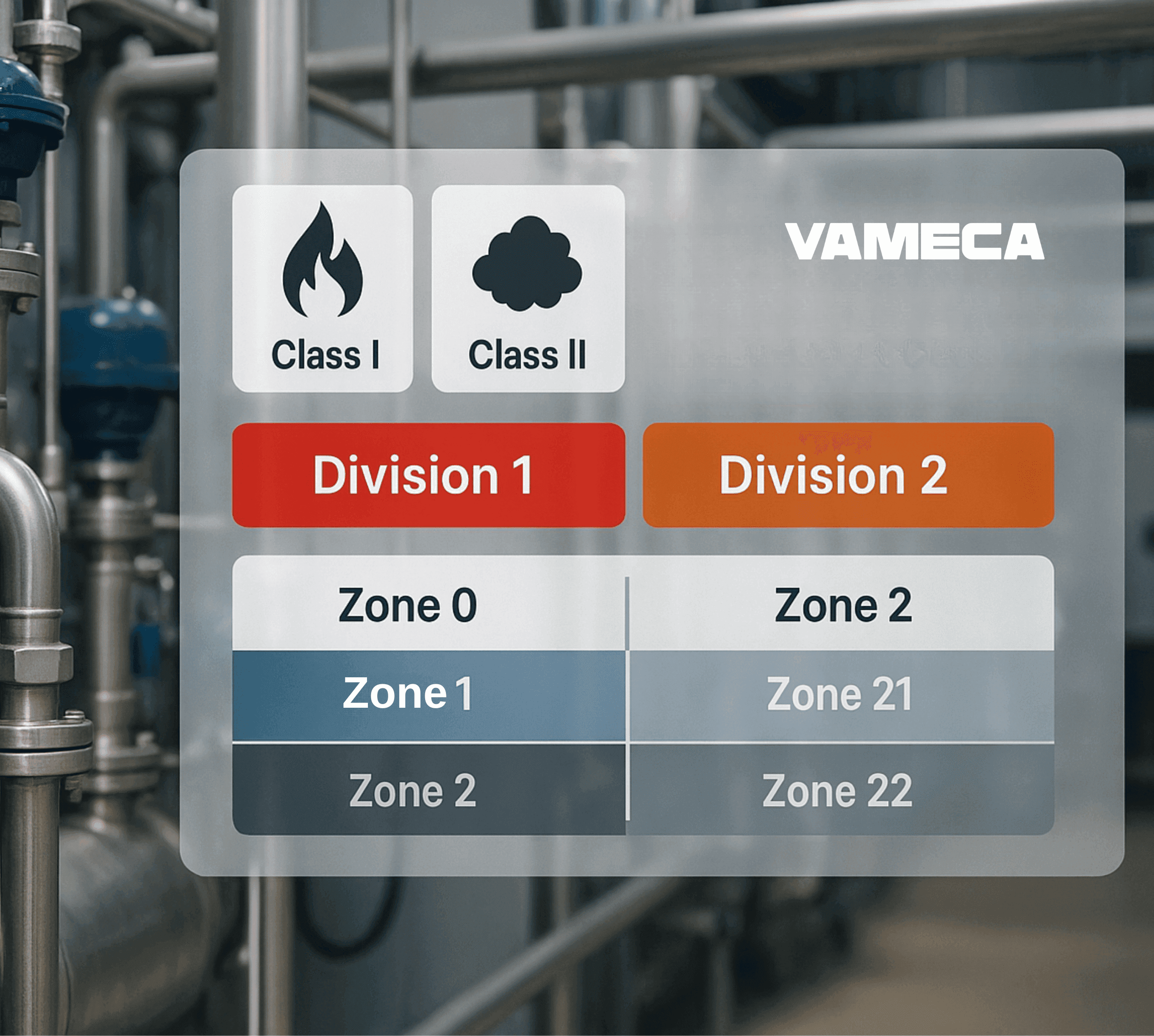
The Classes
The classification begins with the nature of the risk:
Class I: gases and vapors (propane, hydrogen, acetylene).
Class II: combustible dusts (coal, aluminum, flour).
Class III: easily ignitable fibers and particles (wood, textile).
The Divisions
The traditional North American system is based on two risk levels:
Division 1: the hazardous atmosphere is present during normal operation.
Division 2: the hazardous atmosphere is present only in case of anomaly (leak, containment failure, breakdown).
This reference remains the most widespread in industrial installations today.
The Zones
For some recent projects, a more detailed model is used:
Gases (Class I)
Zone 0: permanent or prolonged presence.
Zone 1: occasional presence.
Zone 2: rare and short duration presence.
Dusts (Class II)
Zone 20: permanent presence.
Zone 21: occasional presence.
Zone 22: rare and short duration presence.
International projects and new sites increasingly favor this approach, although Divisions remain dominant in local practices in Canada and the United States.
The Groups
Each class is subdivided by the nature of substances:
Gases (Class I)
Group A: acetylene
Group B: hydrogen
Group C: ethylene
Group D: propane
Dusts (Class II)
Group E: metallic dusts
Group F: coal dusts
Group G: food or organic dusts
Essential Points for Industrial Projects
Inspectors expect clear marking: CSA or UL logo, mention of the class/division or zone, and indication of the group.
Equipment must be accompanied by its certificate and technical sheet.
A mechanical valve alone is not subject to CSA/UL certification, but as soon as it integrates an actuator, solenoid, or electrical enclosure, each component must be certified.
In some cases, the complete assembly (valve + actuator + accessories) must demonstrate its compliance.
In Summary
Divisions remain the reference system in North America.
Zones are progressing with international harmonization.
Classes and Groups define the precise nature of the risk.
Documented CSA/UL compliance is the only guarantee of a successful inspection and valid insurance.
FAQ – CSA/UL and Hazardous Areas
What is Class I Division 2?
This is a North American classification indicating that equipment is designed to operate in an area where flammable gases or vapors may be present only in case of anomaly.
What is the difference between Division 1 and Division 2?
Division 1 corresponds to a constant risk (explosive atmosphere present during normal operation). Division 2 corresponds to an occasional risk (presence only in case of leak or failure).
Are Zones replacing Divisions in Canada?
Not yet. The Zones system (0/1/2 – 20/21/22) is increasingly used, but Divisions remain dominant, especially in existing installations.
Does equipment always have to be CSA/UL certified?
Yes, if it is intended for a hazardous area. Inspectors require clear CSA or UL marking, accompanied by a certificate of compliance.