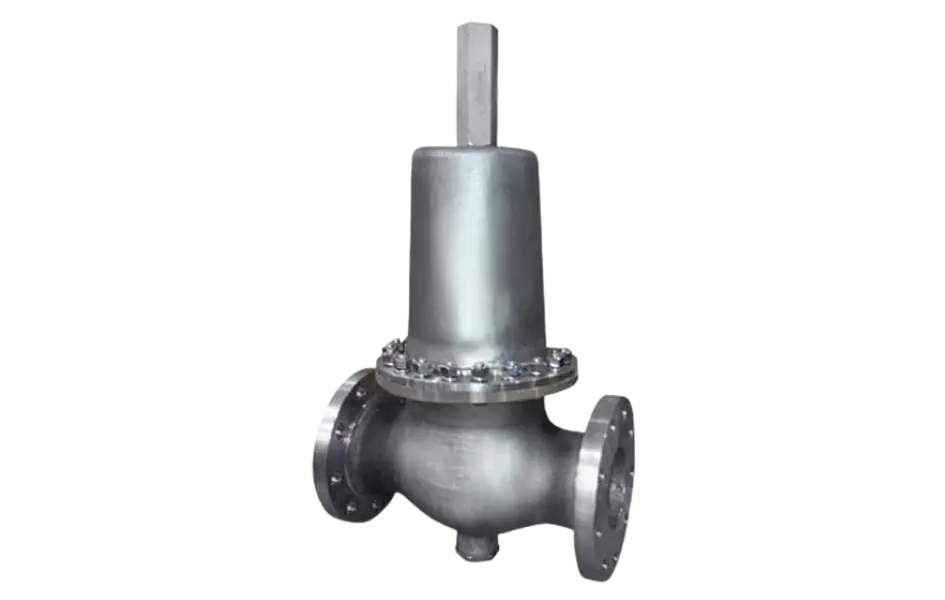
The Warren Controls 476 is a self-operated regulator engineered to maintain a precise upstream backpressure. It is specifically designed by the manufacturer for demanding service in water and seawater applications.
2½ and 3 in · DN65 / DN80
Class 150 and 250
ANSI / MIL-F-20042 Flanges
Cv up to 150 · 165°F max.
The 476 regulates upstream pressure, not downstream
Back pressure refers to the pressure maintained upstream of the valve. A back pressure regulator modulates process flow to prevent upstream pressure from deviating from the operating setpoint. On the Warren Controls 476, this function is completely self-contained: no PLC or electric control actuators are required. The manufacturer specifies this series as fail-closed, meaning its fail-safe state must be factored into your overall system design.
Upstream Pressure
The objective is to maintain upstream pressure at the regulator inlet; this function should not be confused with downstream pressure reduction.
Autonomous Mechanical Response
The 476 is a self-operated regulator: control is achieved through its own internal mechanism, eliminating the need for an external actuator.
Fail-closed position
Warren Controls specifies that the 476 Series is fail-closed. Required fail-safe action must be verified for your specific process requirements and does not replace the need for dedicated, independent overpressure protection.
Marine Service
Documented applications include freshwater and seawater services. Material and connection selections are engineered specifically to withstand demanding shipboard environments.
Series 476: Pressure Ratings, End Connections, and Materials
Selecting the right 476 regulator depends on three key criteria: the required backpressure to maintain, the process piping connections, and the material compatibility with your media.
HYDRAULIC FUNCTION
Maintain backpressure
The 476 maintains a set upstream pressure through self-operated mechanical action. It opens to relieve the flow required to maintain this setpoint and closes when process conditions dictate.
Function
Upstream backpressure
Order
Self-Contained
Fail Position
Fail-closed
Adjustment
Target Upstream Pressure
The upstream pressure to be maintained, the flow rate, and the downstream pressure determine the precise configuration of the assembly.
SIZES AND END CONNECTIONS
ANSI or MIL-F-20042 Flanges
The manufacturer specifies two nominal sizes: 2½ and 3 inches (approximately DN65 and DN80). Available end connections include ANSI and MIL-F-20042 flanges; ensure drilling patterns, face-to-face dimensions, and pressure classes match your existing piping system.
Nominal Sizes
2½ and 3 in.
Pressure Classes
150 / 250
Flanges
ANSI
Marine Flanges
MIL-F-20042
Both sizes are available with ANSI or MIL-F-20042 end connections. The body rating does not indicate the control pressure.
BODY AND TRIM
B61 Bronze or Stainless Steel
The 476 is available with an ASTM B61 bronze or stainless steel body, along with 316 stainless steel or copper-nickel trim. Material selection must be confirmed based on seawater exposure, media treatment, and actual operating temperatures.
Body Material
Bronze or Stainless Steel
Bronze
ASTM B61
Trim Materials
316 / Copper-Nickel
Maximum Cv
150 depending on the model
The selection of a bronze or stainless steel body and internal trim depends on the water chemistry and specific corrosion requirements.
476 Back Pressure or 436 Pressure Relief?
Both series are engineered for industrial and marine piping systems, yet they serve distinct hydraulic functions. This critical distinction must be clarified prior to submitting any replacement request.
WARREN CONTROLS 476
Upstream Pressure Control
The 476 maintains a set upstream back pressure in proven water and seawater applications. The manufacturer specifies a fail-closed configuration.
Sizes and Construction
2½ and 3 in., ANSI or MIL-F-20042 flanges, Class 150/250, bronze B61 or stainless steel body. Maximum range Cv: 150.
Thermal Limit
Rated design temperature of 165°F (approximately 74°C). Additional pressure-temperature limits depend on configuration and operating service conditions.
WARREN CONTROLS 436
Downstream pressure reduction
The 436 Series is a pressure-reducing regulator engineered for precise downstream pressure control. Featuring a fail-open design, its operation is the direct opposite of the 476 Series.
Distinct Specifications and Dimensions
The 436 reduces downstream pressure, while the 476 maintains upstream back pressure. These functions are distinct and are not interchangeable.
Inspect system protection
Fail-closed or fail-open behaviour must be engineered into the overall system requirements and does not, on its own, constitute a certified safety function.
Information required to specify the 476: min/max upstream pressures, backpressure setpoint, flow rates, temperature, flange specifications, and marine service requirements.
Where to Use a Warren Controls 476 Regulator?
Warren Controls specifies onboard fire mains and desalination systems. Other potential applications should be evaluated based on the vessel's hydraulic schematic and operational constraints.
SELF-OPERATED MECHANICAL CONTROL
The 476 operates without an electric motor
The 476 Series is engineered as a self-operated backpressure regulator. It functions using process pressure and an integrated control mechanism, eliminating the need for an external analog setpoint during standard operation. For comprehensive details on the internal mechanism, configuration adjustments, and field-serviceable replacement parts, please consult the specific part number documentation or connect with our local technical specialists.
Holding pressure required
Define the required upstream pressure and the variation range to be accommodated. The setpoint is a key sizing parameter.
Fail-closed operation
Warren Controls designates the 476 as fail-closed. The impact of this fail-safe position on upstream pumps and equipment must be carefully evaluated.
Self-operated, non-positioner
No electric actuators are listed for standard modulating service. Please confirm specifications and custom operating conditions on the manufacturer quotation.
What specifications are required to order or service a Warren Controls 476 valve?
A complete technical inquiry must specify the required back pressure and flow conditions, not just the pipe size.
PRESSURE
Upstream setpoint
Minimum, normal, and maximum upstream pressure, set pressure to be maintained, and downstream system backpressure.
FLOW RATE
Hydraulic Capacity
Minimum, normal, and maximum flow rates, process fluid, temperature, and available pressure drop across the regulator.
END CONNECTIONS
Size and Flanges
2½" or 3", Class 150/250, ANSI or MIL-F-20042 standard, and existing face-to-face dimensions.
DOCUMENTATION
Marine Requirements
Drawings, bill of materials (BOM), testing or qualification requirements, applicable CRN, and project-specific certificates.
THE ADVANTAGES OF VAMECA
VAMECA gathers hydraulic data and vessel requirements to prepare a Warren Controls inquiry. Availability, lead times, applicable documentation, and pricing are verified prior to commitment.
FAQ
Upstream backpressure, key differences from the 436 series, seawater service, marine flanges, pressure classes, Cv values, and safety standards.
Warren Controls 476: Sizing and Quote in Quebec
Whether for a naval project, a seawater manifold, or the replacement of a back-pressure regulator, VAMECA helps you specify a configuration tailored to your site's hydraulic and documentation requirements.
Hydraulic function verified
Verify that the equipment is required to maintain upstream backpressure rather than regulate downstream pressure.
End Connections and Materials
Verify sizes, ANSI/MIL flanges, and materials engineered for fresh water or seawater service.
Supplier Profile
Applicable technical data and documentation, pricing, and availability to be confirmed upon quotation.