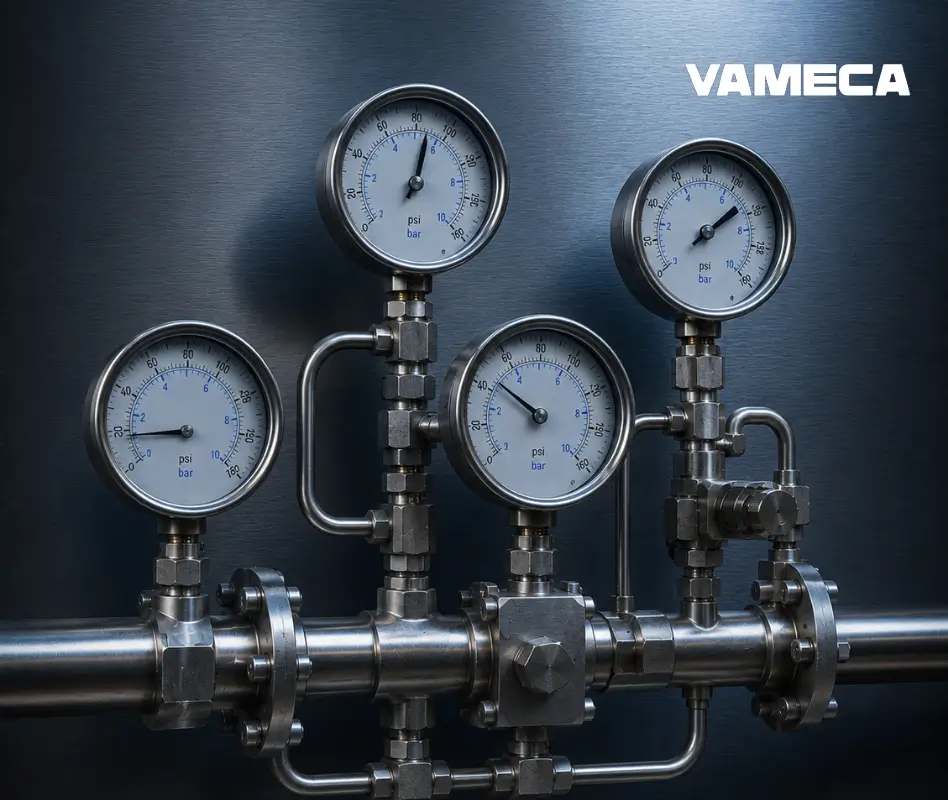
In Canadian industrial projects, confusion between PSI, bar and kPa is a frequent source of specification errors. A European supplier speaks in bar, your ASME standard is in Class, and your municipal client requires kPa. Here is how to make sense of it — and how these units directly influence your valve selection.
1. The three pressure units used in industry
Three measurement systems coexist in North American and international industrial projects, depending on equipment origin and reference standards.
PSI — the North American imperial system
The PSI (Pounds per Square Inch) is the dominant unit in the United States and widely used in Canadian industries inherited from the imperial system: oil and gas, mining, municipal infrastructure. Most ASME catalogued valves are expressed in PSI or in Class (150, 300, 600…).
bar — the European metric system
The bar is the reference unit in Europe and in DIN/EN standards. It appears in Canadian projects as soon as equipment is imported from Europe or a specification uses PN designations (PN 10, PN 16, PN 40…).
kPa — the official SI in Canada
The kilopascal (kPa) is the legal unit of the International System (SI) officially adopted in Canada. It is mainly used in building codes, CSA standards and provincial regulatory documents. In practice, industrial operators often convert to bar or PSI for operating calculations.
2. Practical conversion table
Here are the basic equivalencies and the most common values in industrial valves:
bar | PSI | kPa | Typical application |
|---|---|---|---|
1 bar | 14.5 PSI | 100 kPa | Reference base |
6 bar | 87 PSI | 600 kPa | Standard compressed air (actuator supply) |
10 bar | 145 PSI | 1,000 kPa | PN 10 — water utilities, heating |
16 bar | 232 PSI | 1,600 kPa | PN 16 — standard process |
20 bar | 290 PSI | 2,000 kPa | ≈ ASME Class 150 (at 38°C, carbon steel) |
25 bar | 363 PSI | 2,500 kPa | PN 25 — low-pressure steam |
40 bar | 580 PSI | 4,000 kPa | PN 40 — common industrial process |
51 bar | 740 PSI | 5,100 kPa | ≈ ASME Class 300 (at 38°C, carbon steel) |
100 bar | 1,450 PSI | 10,000 kPa | ≈ ASME Class 600 — high-pressure steam |
⚠ Note on ASME approximations: ASME classes (150, 300, 600…) do not correspond to a fixed pressure. Their allowable pressure varies depending on body material and service temperature. The equivalencies above are indicative for carbon steel at ambient temperature. Always consult the ASME B16.34 tables for your actual application.
3. Service pressure vs nominal pressure: a critical distinction
This is one of the costliest confusions in equipment specification:
Nominal pressure (PN or Class) is the maximum design pressure at reference temperature (usually 20°C or 38°C). This is the value stamped on the valve.
Service pressure is the actual operating pressure, which can vary with temperature, transients and water hammer.
In practice, the higher the service temperature, the lower the allowable pressure of a valve. A stainless steel Class 150 valve supports about 20 bar at 38°C, but only 14 bar at 260°C.
✅ Basic rule: always specify both the maximum pressure AND temperature in service. Pressure alone without temperature is an incomplete specification.
4. How service pressure guides valve selection
Operating pressure is the first filter in selecting an industrial valve. Here are the broad guidelines:
Less than 16 bar (≤ 232 PSI)
NPT threaded connection is acceptable for small diameters (DN 15 to DN 50) on water, air, or glycol systems. PN 10 / PN 16 valves cover the vast majority of industrial utilities.
From 16 to 50 bar (232 to 725 PSI)
You enter the realm of ASME Class 150 to Class 300 flanges or PN 25/40. Threaded connection becomes insufficient: flanges are required to ensure sealing and allow maintenance. Selecting the flange type (Raised Face, Flat Face, Ring Type Joint) becomes critical.
Above 50 bar (725 PSI)
You move to ASME Classes 600, 900 and above. Welded connections (butt-weld, socket-weld) are preferred. High-torque pneumatic actuators such as Scotch Yoke or hydraulic actuators become necessary.
Steam networks: a special case
Steam combines high pressure and high temperature, which systematically requires high ASME Classes with suitable materials (carbon steel, high-temperature stainless steel, graphite packing). The slightest under-specification can cause gasket failures or serious accidents.
5. The most common specification mistakes in Canada
Specifying in bar for a North American supplier
A specification written in PN 40 (European bar) and sent to a Canadian supplier may be interpreted as ASME Class 150 — yet these two designations are not strictly equivalent. In North America, always translate to ASME Class before issuing a specification.
Omitting temperature in the specification
Stating "40 bar" without mentioning "at 250°C" amounts to under-specifying the equipment. The supplier will select a valve that is correct at ambient temperature but out of tolerance in actual operating conditions.
Confusing PN and ISO PN
A PN 100 (European standard) is not identical to an ISO PN 100 (used in petrochemicals). This confusion is common on international projects and should be clarified contractually at the specification stage.
Neglecting transient overpressure
Nominal operating pressure is not the maximum pressure. Water hammer during rapid valve closure can generate pressure spikes 2 to 3 times higher than normal pressure. The selected pressure class must account for these transients.
6. Pressure units and Canadian compliance
In regulatory terms, Canada requires pressure equipment to comply with the CSA B51 code and obtain a CRN (Canadian Registration Number) in each province of use. These requirements apply regardless of the pressure unit used in the specification.
Equipment imported and certified to ASME must still undergo provincial CRN registration — ASME compliance alone is not sufficient in Canada.
In summary
Unit | System | Canadian usage context |
|---|---|---|
PSI | Imperial | ASME valves, oil and gas, mining, American equipment |
bar / PN | European metric | Equipment imported from Europe, DIN/EN standards |
kPa | Official SI in Canada | Building codes, CSA standards, regulatory documents |
The right reflex in a Canadian project: always convert pressure to ASME Class for equipment selection, and verify the actual allowable pressure according to material and service temperature in ASME B16.34 tables.