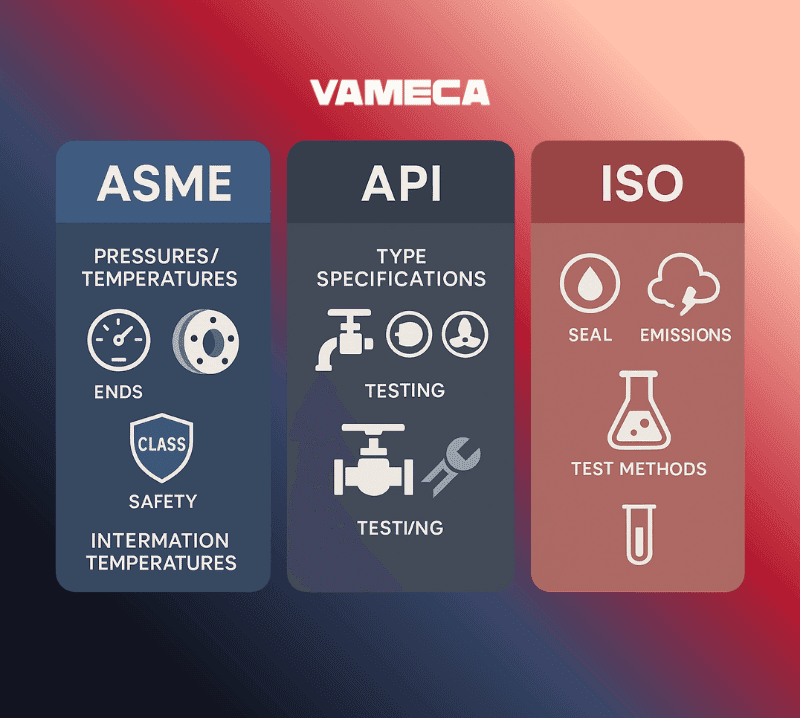
An “ISO/PN compliant” label that works in Europe can slow down a project in North America. Here, the backbone remains ASME (pressure/temperature, end connections) and API (type-specific specifications + testing). ISO is used mainly for testing methods (e.g., ISO 5208, ISO 15848) when requested by the customer or to harmonize practices. The right approach: use ASME as the backbone, then add API or ISO without creating contradictions.
1 - The three families: Roles and scopes
ASME (American Society of Mechanical Engineers) - The pressure/temperature foundation & end connections
ASME B16.34 defines pressure/temperature ratings by class (Class 150/300/600/900/1500/2500), by material (material groups: carbon steel, stainless steel, alloys), and imposes minimum thickness, design, and test requirements.
The end connections refer to other ASME standards:
B16.5 (flanges NPS 1/2 to 24),
B16.47 (flanges beyond NPS 24),
B16.25 (BW welded ends),
B16.11 (SW ends) and B1.20.1 (NPT threads).
In North America, people speak in NPS/Class rather than DN/PN. ASME B16.34 remains the safeguard to verify that the valve withstands the stated conditions.
API (American Petroleum Institute) - Type-specific specifications & testing
API 600: gate valves cast steel, bolted bonnet (refining).
API 602: compact gate/globe/check valves (small diameters, forged).
API 608: metal ball valves, threaded, flanged, welded ends.
API 609: butterfly valves Lug/Wafer types (cat. A/B).
API 598: leakage tests for body/seat and acceptance criteria by valve type.
API 607 / API 6FA: fire-safe tests (in practice, 607 for soft-seated quarter-turn valves; 6FA more of a “general fire” test).
API 641: fugitive emissions (quarter-turn valves with packing).
🛢️ In oil & gas/refining, API is the native language.
ISO (International Organization for Standardization) - International test methods
ISO 5208: leak-tightness test methodology with classes A to G (A is the most stringent).
ISO 15848: fugitive emissions (tightness/endurance classes).
🌐 ISO is useful for aligning global suppliers. However, it is important to specify the class and not layer it over API 598 without a defined hierarchy.
2 - How to specify in a Canadian tender
Petrochemicals / Refining
To specify: ASME B16.34 (class + material) + API by type (600/602/608/609) + API 598.
Add: API 607 if the valve has soft seats & API 641 or ISO 15848 if the project requires certified fugitive emissions performance.
This facilitates QA/QC (Quality Assurance / Quality Control) audits and facility maintenance.
Water / Municipalities
To specify: ASME B16.34 (class + material) + ISO 5208 (state the leak class) or API 598.
This provides technical fit without over-specifying. Adding heavier standards when they are not needed increases costs without adding value in standard applications (water, steam, air, common process).
Steam & utilities (High pressure + High temperature)
To specify: ASME B16.34 → design and mechanical strength standard. It provides the pressure/temperature curves by material: this is what tells you whether a valve in A105, F316, etc., can withstand X bar at Y °C.
To specify: API 598 or ISO 5208 → these are the leak-tightness test standards (hydrotest, leakage tests). Choose one protocol (either one), but do not duplicate unnecessarily.
Key point : seats & packing compatible (filled PTFE, PEEK, metal-to-metal) according to T/ΔP (temperature and differential pressure) and cycling. Example: PTFE = good for moderate utilities, but not stable at 250 °C; metal-to-metal = robust in HP/HT but more expensive.
💡 Good reflex : always ASME B16.34 first (class, material, end connections), then API 598 or ISO 5208 (not both without hierarchy), and, if needed, API 607/641 or ISO 15848 as supplements.
3 - Frequent errors
Mixing Class and PN on the same line
✔︎ Choose a primary reference (NPS/Class in Canada/USA). Provide an indicative PN↔Class table (for reference), but size exclusively with ASME B16.34.
Stacking API 598 & ISO 5208
✔︎ One single leak-tightness test protocol. If ISO 5208, state the class. If API 598, there is no need to add ISO 5208 unless required by the project, but with a clear hierarchy.
Forgetting local maintenance
✔︎ Check the standard interfaces (e.g., ISO 5211 for actuator mounting pads), seat/packing kits, and local availability in North America of parts. This point saves weeks of downtime.
4 - Decision method in 5 criteria
Safety/Compliance: ASME B16.34 (class, material) vs actual P/T curves.
Performance: API 598 or ISO 5208 (class), plus API 607 / API 641 / ISO 15848 if required.
Process compatibility: fluid, T, P, corrosion/abrasion, cycling.
Maintenance: standardization, ISO 5211, kits, North American network.
Total cost & lead time: purchase + energy (losses/leaks) + MRO + supplier lead times.
Purchase = purchase price of the valve.
Energy = excess consumption due to losses or leaks.
MRO = Maintenance, Repair and Operation: everything related to the valve’s operational life cycle, costs linked to maintenance, repair, spare parts, maintenance labour, production shutdowns…
Supplier lead times = the delivery time for parts and equipment.
What VAMECA does:
We turn your technical criteria into a simple selection sheet with two compared options (A/B).
Each option highlights the impact on cost and lead time and lists the required documents: MTR (Material Test Report - material certificates), WPS/PQR (Welding Procedure Specification / Procedure Qualification Record - welding procedures), test reports, CSA/UL/FM/Ex certifications for classified areas.
Result: you save time, avoid unnecessary over-specification, and secure compliance from the outset.
☎︎ Contact Vameca today to simplify your choices and accelerate your projects.
5) PN ↔ Class table
ASME Class | Indicative PN* |
|---|---|
150 | ~PN 16 |
300 | ~PN 25 |
600 | ~PN 100 |
900 | ~PN 150 |
1500 | ~PN 250 |
2500 | ~PN 400 |
* Indicative ≠ calculation basis. Always refer back to the P/T curves of ASME B16.34 and the material actually supplied. The equivalence between American pressure classes (ASME/ANSI) and European PN (Pressure Nominal) is not exact, because the two reference systems do not use the same calculation bases (pressure/temperature, materials, safety factors). ⚠️
6 - Acceptance FAQ
Can you size to ASME and accept to API?
Yes. That is the recommended practice: use ASME B16.34 for sizing (pressure/temperature, material) and API 598 for acceptance after testing (or ISO 5208 if requested and properly defined).
What if an existing site is in PN and the new section is in Class?
Use NPS/Class as the primary reference. Provide an indicative PN ↔ Class table to help with cross-referencing, but always validate against ASME B16.34 (pressure/temperature curves + material).
Is an “API Monogram” required?
The monogram applies to manufacturers only. As a distributor/integrator, the priority is to provide the documents required by the customer: MTR, API 598/ISO 5208 test reports, certificates, and full traceability.
Conclusion
In North America, the most reliable approach is to use ASME B16.34 as the design reference, rely on API 598 for acceptance testing, and use ISO only when a specific test protocol is required. It is essential to avoid mixing PN and Class systems on the same piping line and to define one clear test protocol. This approach ensures compliant purchasing, unambiguous acceptance, and controlled local maintenance.