Electric Actuators in Stock: Preparing for a Replacement
Electric Actuators in Stock: Preparing for a Replacement
Electric Actuators in Stock: Preparing for a Replacement
Is an actuation issue delaying your plant shutdown? Identify the motion type, torque, control requirements, and mounting hardware to verify the actual lead time.
The actuator nameplate indicates a part number, voltage, and sometimes a torque rating. To replace the unit during a planned shutdown, a critical piece of information is often missing: how is its motion transmitted to the valve? An off-the-shelf actuator may still require a custom-machined coupling or mounting bracket.
Identify the valve before comparing actuators
A ball valve typically requires a quarter-turn rotation. A globe valve may require linear stroke travel. For the former, record the required torque and rotation angle. For the latter, record the thrust, stroke length, and fail-close direction. A photo of the valve-to-actuator mechanical interface serves as a valuable supplement to photos of both nameplates.
Verify what the PLC actually controls
An open/close command, an analog control signal, and a position feedback signal serve three distinct functions. Note the control type used, the signals actually wired, the available supply voltage, and the failsafe position required upon loss of power. Also verify the stroke time and the expected cycle frequency. A continuously modulating valve places significantly different operational demands on the motor than an isolation valve cycled twice a day.
How local stock impacts lead times
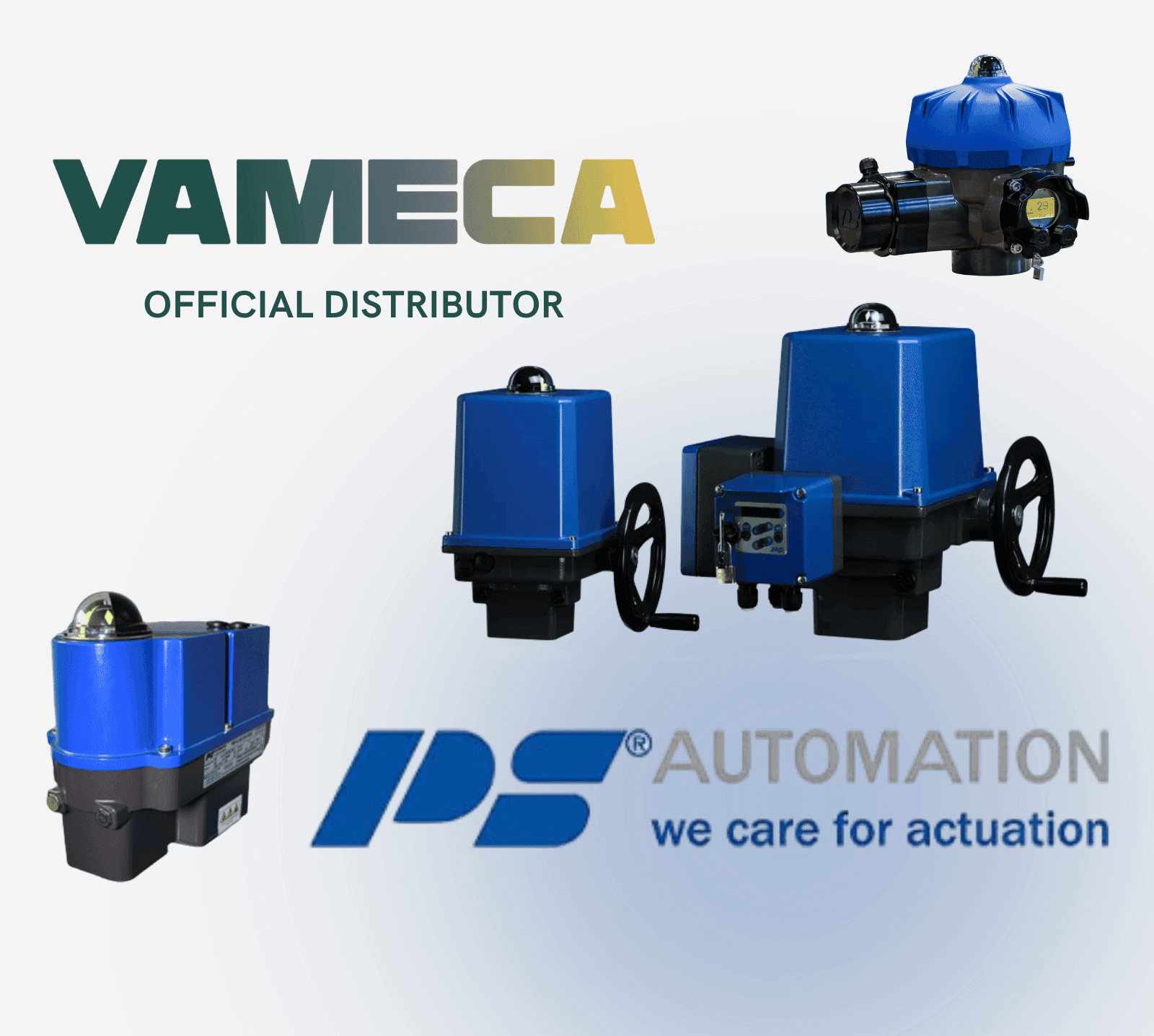
VAMECA maintains an inventory of PS Automation electric actuators. For in-stock part numbers, delivery within a few business days is achievable. The critical lead time to align with your turnaround schedule is that of the fully assembled, ready-to-mount package—including all adaptation hardware and accessories.
Drop-in replacement. Compare the complete model code, including all suffixes and configuration settings to be matched.
Brand retrofit. When replacing a Rotork, AUMA, or other third-party unit, provide the mounting drawing and wiring schematic. Matching mounting flanges alone does not guarantee the correct travel stroke or control compatibility.
Special features. If hazardous location ratings or a fail-safe mechanical return are required, have the option verified against the available inventory.
An actionable inquiry often comes down to two photos, a schematic, and a target date: the valve nameplate, the actuator nameplate, the mounting interface, and the exact date the complete package must be ready for installation on site.